
Opponents of so-called hyperscale data centers are calling on Minnesota lawmakers to adopt stronger regulations this session, including a two-year pause in new construction.
They say requirements for data centers that the Legislature passed last year aren’t enough to protect communities, residents and the environment from the potential negative impacts of the mega-sized facilities.
"We have no regulatory framework in place to protect our communities and the environment from the detrimental impacts of these facilities,” Eleanor Dolan of Duluth said at a rally Wednesday at the state Capitol.
Data centers are large warehouses that store computer servers and power artificial intelligence. The largest ones cover over a million square feet — the equivalent of dozens of football fields.
Data center developers promise they'll bring jobs, economic growth and tax revenue. But opponents have voiced concerns about the vast amount of energy and water they consume, plus potential air, noise and light pollution.
Only one hyperscale data center — a Meta facility in Rosemount — is currently under construction in Minnesota. But there are at least a dozen proposed in the state.
Several are in the south Twin Cities metro. But others are in small cities, such as Hermantown, Pine Island and Cannon Falls.
Dolan is a member of a group called Stop the Hermantown Data Center. Residents there have said they felt like the proposal was greenlit without taking their concerns into account.
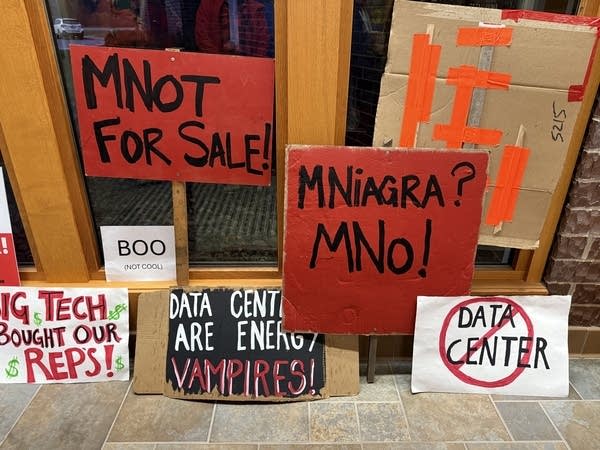
Opponents worry that without state oversight, the decision of whether to approve data center projects is left to local government officials.
“They are incapable of saying no to developers,” said Pine Island resident Aubree Derksen at Wednesday’s rally. “In the absence of solid state regulations, they have shown themselves to be inept at putting in the needed guardrails to prevent their communities from being harmed.”
Last year, state lawmakers struck a deal on data centers that extended a lucrative sales tax break for the projects, and added some new requirements.
Data centers now must consider using measures to reduce the amount of water they need to cool equipment. And utilities can't pass the cost of supplying them electricity onto other customers.
But some say those rules don’t go far enough. A coalition of groups is asking the Legislature to pass a slate of new regulations, including a two-year pause on new data centers.
"Until we put the brakes on this, we will not have the time to develop the regulatory framework needed to protect Minnesotans,” said Aaron Klemz, chief strategy officer for the nonprofit Minnesota Center for Environmental Advocacy.
MCEA has sued over proposed data centers in Lakeville, Hermantown, North Mankato, Pine Island and Faribault. The lawsuits argue that the cities didn't adequately review the projects.
Klemz said a moratorium on new data centers would allow time for a comprehensive study of their potential impacts.
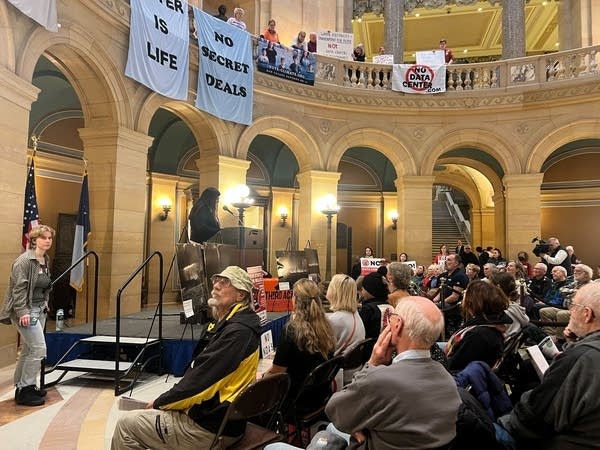
The groups also want to prevent local officials from signing non-disclosure agreements with data center developers that prevent the public from finding out about the projects.
They want the state to require an in-depth environmental impact statement for large data center projects. And they want to require the facilities to conserve water and meet their energy needs with new solar, wind or batteries.
"If you want to be here and operate here in Minnesota, what can you bring to the table, so that you're not burdening the folks and the businesses who already are here?” said Sarah Mooradian with the nonprofit environmental group CURE.
The opponents say they know it's unlikely lawmakers will pass all of their proposals this session. But they hope at least some of their demands gain traction.
In the meantime, without state laws governing data centers, some cities are taking their own measures.
On Tuesday, the city of Eagan passed a one-year moratorium on new large data centers. It’s believed to be the first Minnesota city to take such action.
MPR News reporter Nicole Ki contributed to this report.