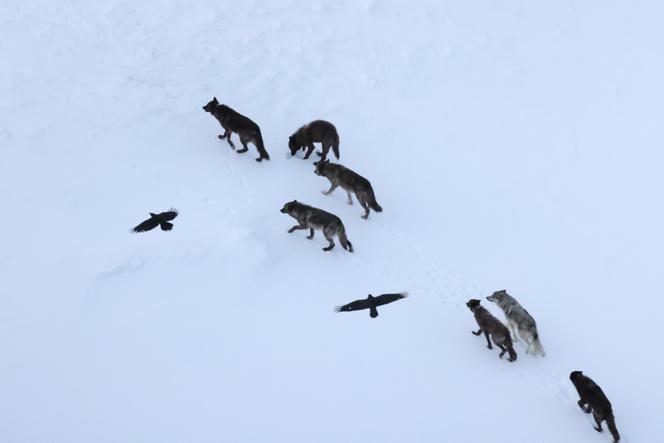
The greatest discoveries almost always begin with simple questions. One such question had been on the mind of John Marzluff, professor of zoology at the University of Washington, for several years: “We knew from our previous work that seeing a wolf is a guarantee of also seeing a raven. Why is the opposite not true?” He continued: “In other words, we knew a lot about the relationship between these two species from the wolf’s perspective, but very little from the raven’s.” This realization was all the more frustrating for someone like Marzluff, who has spent his life studying corvids around the world.
Dan Stahler, a biologist at Yellowstone National Park, had never asked himself that question. For nearly 30 years, he had been monitoring wolves, reintroduced into the park in the early 1990s, and their constant presence alongside the large black birds seemed self-evident. “For us, the ravens’ strategy was obvious: stick as close to the wolves as possible,” he said. “In reality, we had no idea, because we never put them at the forefront of our observation.”
To shift this perspective, the two American researchers combined their efforts, joined by Matthias-Claudio Loretto, then at the Max Planck Institute, now assistant professor at the University of Veterinary Medicine in Vienna. They first managed to capture 69 ravens, a delicate task given their intelligence allows them to evade most traps. The birds were then fitted with GPS trackers and their movements recorded. Finally, these movements were compared to those of 20 wolves, already being monitored via radio collars.
You have 54.71% of this article left to read. The rest is for subscribers only.