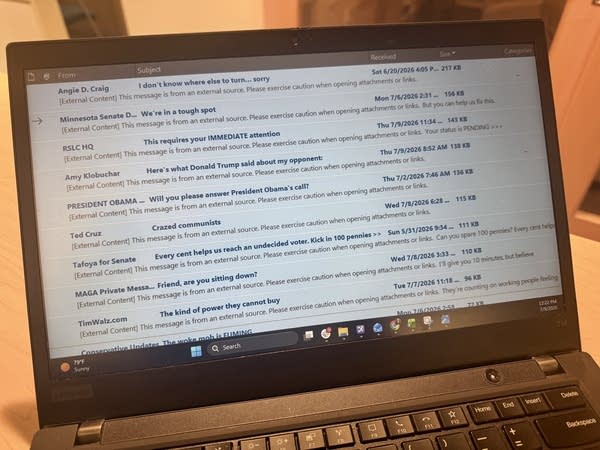
Anyone who has ever shown a slight interest in politics might be watching their email inbox fill up with pleas for money. Political fundraising emails are out in full force with urgent appeals to shake loose small-dollar donations.
They go to people who perhaps signed up for updates from a political candidate, visited a campaign website or previously donated to a political cause.
The subject lines stand out:
"Please read before deleting."
"We really need your help"
"Trump said WHAT?!"
And it’s not just from candidates the email recipient has previously supported. A Minnesota voter might get hit up by campaigns in Texas, California or Florida.
Welcome to the world of political fundraising emails.
The emails are personalized. Sometimes pleading or desperate. Or from time-to-time they are shaming. They can be manipulative or look like a phishing attempt.
"We've reached out to you time and time again — will you PLEASE respond?"
"Action required: your voter profile needs immediate verification."
"Leadership chose YOU, Patriot. Don't let them down."
"IMPORTANT SOCIAL SECURITY ANNOUNCEMENT"
“They are a cost-effective way to reach out to voters, particularly small donors who might be inspired to contribute even small amounts to political campaigns,” said Costas Panagopoulos, a distinguished professor at Northeastern University who studies political campaigns.
“Small contributions, which is typically what's solicited using these email tactics, are becoming increasingly important for political campaigns and constitute a larger and growing share of political contributions,” he said.
Those donations are important for any campaign. But for one like Lt. Gov. Peggy Flanagan, they’re essential. She stresses how she's refusing corporate-linked political action committee money for her Senate campaign.
“So it is folks who, you know, are donating $5, $10, $25,” Flanagan said. “And you know that means that once people contribute, they are absolutely invested in this campaign.”
Flanagan said she's had more than 75,000 donors to her campaign. Panagopoulos said the small donations are a measure of a campaign's reach.
“It's not just the total amount of money that campaigns are raising, but the total number of contributions that becomes a proxy for their level of support in the electorate,” he said.
Email fundraising brings about $360 million a year into political campaigns, said Eric Wilson, the executive director for The Center for Campaign Innovation. The organization helps conservative candidates better use technology in their campaigns. Wilson worked on several campaigns and was the digital director for Marco Rubio's 2016 presidential bid.
Campaigns build their own lists of potential donors and might also buy email lists from past campaigns or political list brokers. That's why donors find that once they give to one candidate, they're suddenly getting messages from others.
"The best indication of a future behavior is past behavior, and so if someone has donated in the past, they're very likely to donate again in the future,” Wilson said. “And so campaigns want to be sending emails to those people.”
Those lists and the labor for email fundraisers can add up. Wilson said that typically it will cost $38 to raise $100. To get the most out of those potential donors, campaigns will email often — in part to get through spam filters — and they'll use different strategies to get the recipient to click.
Erika Franklin Fowler, a professor of government at Wesleyan University and the director of the Wesleyan Media Project, which studies campaign advertising, said the tactics usually fall into two categories.
One is fear appeals.
“You know this is your last chance, or we really need this, or something bad will happen,” Fowler said.
Another is social desirability.
“Fear of being singled out, sort of that ‘Your neighbors are doing it; you haven't’ social pressure,” Fowler said.
Some go further, looking like a personalized email. Or warning you're in danger of getting behind on a bill.
While many might find getting these emails annoying, Wilson said there's not much evidence that it backfires.
“Campaigns and their operatives would not be sending them out if they weren't effective,” Wilson said.
With the midterms election still months out, the email barrage won't end anytime soon.