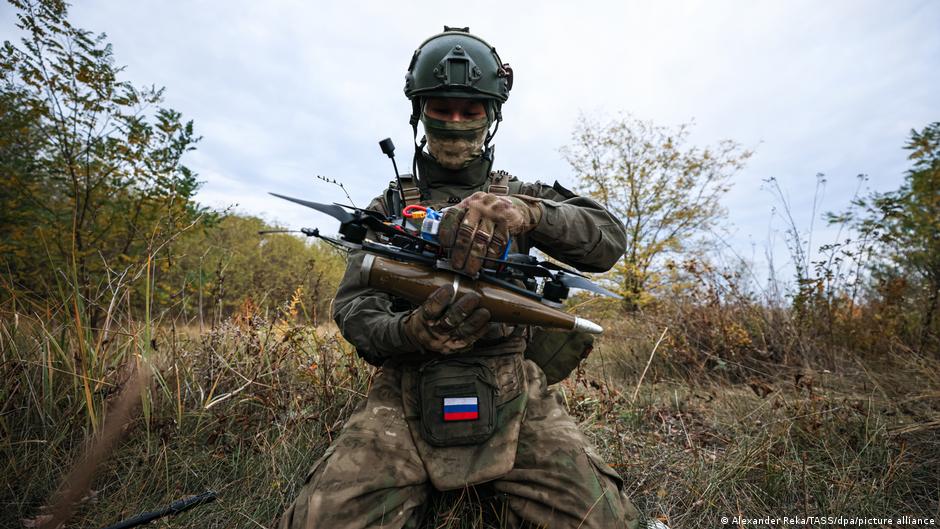
Students are being recruited at universities and other educational institutions around Russia for the Russian Defense Ministry’s drone units. Often they are promised a one-year contract, around 5 million rubles (about €50,000, $58,000) and free tuition after their stint in the military, as well as being told that they will be deployed at a safe distance from the front in Ukraine.
But observers say the students are being misled and duped into signing permanent contracts. At worst, they are being sent to the front, where the risk of death or injury is high.
According to information on university websites and posts by students on Telegram channels, universities have been organizing meetings with representatives from recruitment offices and military training centers to inform students about the purported benefits of signing contracts with the Defense Ministry.
The Russian-language information portal Echo reported that at least 70 educational establishments in 23 regions, including the annexed Ukrainian peninsula of Crimea, are involved in recruitment. Nearly half are located in the Russian capital Moscow and St. Petersburg.
No standard format for recruitment
Yuri, who works at a Moscow university and who spoke to DW using a pseudonym for security reasons, said that the heads of various universities had been summoned to a meeting with Russian Deputy Prime Minister Dmitry Chernyshenko, who is also the minister responsible for education and science. They were instructed to organize the recruitment of students at their universities for service in Russian drone units.
“There is no standard format for the recruitment, every university has its own,” said Yuri, explaining that representatives from the draft boards, veterans of the “special military operation” — as the war against Ukraine is officially referred to in Russia — and university staff held group discussions with students.
In some regions, the local education ministries have issued guidelines on how universities should organize recruitment efforts. According to a February report in the independent Russian news outlet The Insider, university administrations have also sent emails offering students contracts with the Defense Ministry.
According to another independent media platform, T-invariant, many universities are now involved in recruitment, including ones that have nothing to do with the development or use of drones.
“First it was students from technical universities, then those facing expulsion, and now it has reached all students,” T-invariant wrote. “Universities have been given recruitment quotas, students are being lured with additional university payments and threatened with denial of retakes for failed courses.”
“From what I’ve observed, a quota has been set for each university — between 0.5 and 2% of the total student body,” Yuri continued, adding that if a university administration failed to meet those targets, it might be suspected of being disloyal.
“In such a case, the rector or vice rector risks losing their position,” he said. For example, the failure rate at his university has risen sharply recently, he recounted, and students at risk of expulsion faced the choice of either signing a contract with the army to serve in a drone unit or doing military service.
Students not protected by Russian law
Promotional materials distributed at universities claim that students can sign a one-year contract and then return to civilian life. But Artem Klyga, a lawyer with the Movement of Conscientious Objectors, an NGO that has been classified as a “foreign agent” in Russia, pointed out that short-term contracts were not in line with current laws.
He said that the contracts students were signing were effectively open-ended, at least until Russian President Vladimir Putin puts an end to partial mobilization. Klyga said that court rulings had confirmed that the contracts were open-ended.
Russian law did not guarantee that a person would only serve in the drone units, either, he explained. “If you sign a contract and fail to meet the requirements, this does not mean termination of the contract or discharge. You are simply transferred to another unit and assigned to a different military position by order of the commander,” Klyga said.
The Get Lost (Idite Lesom) movement, which is based in Georgia and provides support to deserters from Russia, has received reports of broken promises. In one example, students from a St. Petersburg college signed contracts with the Russian Defense Ministry that promised they would be posted at a local military facility to work on military equipment. But they were later informed they would be working on the frontline as drone pilots.
A similar fate befell a contract soldier who spoke with DW in early January and asked not to be named. He said that he had been promised a position with the command staff when he signed his contract, and this had been the case initially.
But after a few months, he had suddenly been transferred to an engineering unit for mine clearance. DW lost contact with him at the end of January and has since heard that he was killed in the Kharkiv region.
Yuri told DW that he was not aware that students at his university had signed any contracts with the Defense Ministry. He said he always tried to warn them against it, but that it was not easy to talk openly, as he could be reported to the university administration. In any case, some students were already well aware that no money in the world could compensate for a disability or death, he added.
Yuri said that for a time, he had tried to focus on his academic work. “Up to a point, I was able to keep myself out of this war. But now the universities are turning into barracks. My humanist worldview won’t allow me to send my own students there [to war],” he stated.
This article was originally published in Russian.