TREVOR NELSON: He just drove by taking photos of us.
BREY MAFI: I saw that.
TREVOR NELSON: And that’s going to go straight back to the office.
SUBJECT 1: That’s OK.
BREY MAFI: We all have a lot inspection. If I’m with anybody, I give a lot of tours for a variety of reasons. And typic– yeah, this is just very typical.
TREVOR NELSON: Yeah.
BREY MAFI: Which is why people tend to stay quiet.
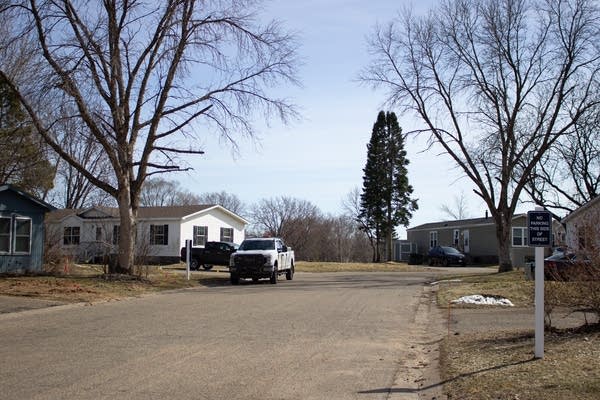
CAIT KELLEY: I’m walking with a few Cimarron Park residents, including Trevor Nelson and Brey Mafi, that last voice you heard, through their mobile home community in Lake Elmo. It’s a blustery but sunny day. A park worker drives past with his cell phone sticking out the window, pointed at us. Nelson says he feels surveilled and trapped.
TREVOR NELSON: When I first moved in, we had our first rent increase and I believe it was about $40 a month, and I was genuinely surprised at how big the increase was.
CAIT KELLEY: He says he asked the park manager about it.
TREVOR NELSON: Without missing a beat, she just looked at me and said, because we have shareholders to pay. I did not know how to respond to something that blunt.
CAIT KELLEY: Cimarron is a big park with about 500 lots. It was bought in 2011 by Equity LifeStyle Properties, or ELS, a public company from Chicago that owns parks in 23 states. Cimarron is one of about 800 mobile home parks in Minnesota. Most residents own their homes but rent the land underneath.
When Nelson moved here in 2018, he says lot rent was about $700. Today, he says it’s more than $1,000 and goes up every six months. In a statement to MPR News, ELS said the rent increases are in line with similar housing in the area. The company says rent has gone up about 6% annually. Nelson supports a bill that would limit lot rent increases.
TREVOR NELSON: Every year that passes makes this no longer qualify as affordable housing.
CAIT KELLEY: If a park owner wants to sell, the bill would also require them to give the residents a chance to buy the park themselves. In Minnesota, 15 parks are owned by the residents.
NATIVIDAD SEEFELD: Where do you want to start? Do you want to just start walking?
CAIT KELLEY: One resident-owned community is in Fridley, just north of Minneapolis.
NATIVIDAD SEEFELD: Good morning.
SUBJECT 2: Good morning.
NATIVIDAD SEEFELD: It’s so fun here. I just love it here. I would never move. I’m going to pass away here.
CAIT KELLEY: Natividad Seefeld is the president of Park Plaza cooperative. Here, lot rent pays back the loan the residents took out to buy the park. Seefeld says lot rent has stayed at $545 for two years. Last year, Seefeld testified at the Capitol that residents deserve time to make an offer to buy their parks. Residents often don’t know their community is being sold until the sale is finalized.
NATIVIDAD SEEFELD: We just want the opportunity to be able to take control of our lives and have a safe place to live, and not have to worry about becoming so expensive. We can’t live there anymore.
CAIT KELLEY: Not everyone supports the bill. ELS wouldn’t comment on the bill, but said in a written statement it regularly revitalizes Cimarron Park, and the park provides key affordable housing in its area. Minnesota Park owners testified that the bill has too many complicated requirements. Mark Lambert of Summit Management owns eight mobile home parks.
MARK LAMBERT: I’m a community owner for 42 years. I purchased a small community in 1984. I still own and operate that community. I am not private equity.
CAIT KELLEY: Lambert says the bill doesn’t acknowledge rising industry costs, and it unfairly privileges co-ops.
MARK LAMBERT: This feels like a hammer that squashes a lot of people that haven’t done wrong. Perhaps a couple of those private equity guys have done wrong. I certainly would be upset as well.
CAIT KELLEY: The bill’s future is unclear, but Trevor Nelson, one of the residents who was filmed as we spoke at Cimarron Park, has a message for his legislators.
TREVOR NELSON: These out-of-state corporations aren’t the ones that are voting for them in November. It’s their constituents. It’s the people that they are supposed to be there taking care of.
CAIT KELLEY: Nelson will be the one doing the watching as the bill is debated at the Capitol.
NINA MOINI: That was Cait Kelley reporting from a couple of manufactured home parks near the Twin Cities. She’s also been keeping tabs on the legislation inside those hearing rooms at the State Capitol. She joins me now in the studio to talk more about her story. Thanks for being here, Cait.
CAIT KELLEY: Thanks for having me.
NINA MOINI: We heard in your piece there about these efforts set to set these rent caps and other regulations. How would this proposal that backers called the manufactured home residents bill of rights work?
CAIT KELLEY: So the bill does three main things. The most controversial at the legislature is it would limit lot rent increases. That’s really important to residents because most of them own their homes, but they rent the lot or the land underneath. Residents say corporate owners price them out of their homes because rent can go up $30, $40, $50 twice a year and residents can end up losing everything.
There’s only two ways to leave a park– you can either move your home, which can cost tens of thousands of dollars, or you can sell it. And the more rent goes up, residents say, the harder it is to sell. The second thing the bill does is it provides an opportunity for residents to purchase the park themselves. That’s important because right now, sales of parks are usually private, and residents have no idea that their park is being sold until it happens.
So the bill would require park owners who want to sell to give a heads up to residents and give them a chance to actually come together and make an offer to buy the park collectively. There are 15 resident-owned communities or cooperatives in Minnesota right now. And then the third thing the bill would do is provide greater transparency for residents. It would require park owners to provide itemized billing and explain why rent is going up.
NINA MOINI: So where does it stand right now in the legislative process?
CAIT KELLEY: So the bill is stalled in committee in the House. The House is split 50/50 Republican and DFL. It’s really hard to pass bills right now without full bipartisan support. But the bill did make it through the committee process in the Senate and is lined up for debate on the Senate floor. At least one Republican Senator has committed to supporting the bill in the DFL-led chamber.
NINA MOINI: Have residents of mobile home parks been pretty active at the Capitol as well?
CAIT KELLEY: Yeah, residents have testified in favor of this bill and similar bills that failed in previous years. This year, legislators heard from retirees who say they’re being priced out of their communities. One resident showed up with a stack of more than 3,000 signatures from other park residents in support of the bill.
The message from all the residents to the legislators is basically affordability shouldn’t be partisan. One resident said she’s a Republican, but she’s going to be voting DFL in the upcoming election because her increasing rent is the biggest issue she faces.
NINA MOINI: What about the park owners, Cait, particularly those that are headquartered outside of Minnesota?
CAIT KELLEY: So this bill is really targeted at curtailing corporate ownership of parks. And a lot of those companies are from out-of-state. Over the last few decades, local mom and pop owners have been selling parks to big companies, sometimes for tens of millions of dollars. So residents say when out-of-state companies buy their parks, rent goes up dramatically to pay back that big initial price tag. Some of those companies are public, some are private investment firms.
Those companies, to answer your question, haven’t spoken up a whole lot for themselves in committee hearings. But one example, Havenpark communities, a Utah-based investment firm that has owned mobile home parks in Minnesota since 2019. Havenpark has opposed similar Minnesota legislation in the past, saying that they have invested a lot of money in their Minnesota communities. And Havenpark pays for lobbyists in Minnesota to lobby on manufactured housing bills.
Folks who have shown up to the hearings are some Minnesota Park owners who testified against the bill. They say that they aren’t private equity, and they take good care of their parks and the residents who live there. They argued the bill has too many onerous requirements like itemized billing. They also worried that even if they raise rents within the confines of the law, but maybe higher than the 3% increase, that’s allowed, but the increase fits one of the exceptions in the bill, they worry that that’s going to open them up to litigation from residents.
NINA MOINI: So has this been one of those proposals that has pretty much been falling along party lines?
CAIT KELLEY: In the House, it definitely has. Backers thought they might have a chance to get it through a committee, but it failed to have a majority, so it stalled there for now. There is one Republican State Senator backing it. That’s Jim Abeler of Anoka. He also has his own bill that gets a hearing next week, and that deals with evictions in mobile home parks.
NINA MOINI: So when might we know how all this plays out?
CAIT KELLEY: Lawmakers return next week after a mid-session recess. They’ll really start polishing up bills that will reach floor votes then. I would expect the Senate to move something to a vote. The House is the question mark here. The session must end by May 18, so we’ll have a final answer by then.
NINA MOINI: Thanks so much for sharing your reporting with us, Cait.
CAIT KELLEY: Thanks for having me.
NINA MOINI: Cait Kelley is a politics fellow for MPR News.