Minnesota lawmakers working now to write a law to prevent grooming of children by adults in schools are parsing through the same questions district administrators, sports officials, caregivers and others have struggled for years to answer: What is grooming and how do we stop it?
Experts say it’s incredibly difficult to recognize, legislate and prevent this aspect of child abuse — but it’s not impossible.
“The difficulty with grooming is that most of us can't identify it,” said Dr. Mark Hudson, a Children’s Minnesota physician who specializes in handling cases tied to possible child abuse.
“The things that are grooming are things that are normal activities oftentimes, and that’s where making specific grooming legislation is really hard,” Hudson added. “Then you have to get into intent.”
Writing law around it is especially complicated because the abuse often happens over years with actions that in isolation seem harmless.
Grooming is “a pattern of boundary-crossing behaviors that is about building trust, secrecy and then dependency. It’s rarely dramatic, it’s rarely the things that would even trigger as a red flag,” said Monica Rivera, vice president of education and research at Safe Sport, a nonprofit created in the wake of sexual misconduct at USA Gymnastics.
“It often looks like special attention, isolated one-on-one time, private communication, bending small rules in ways that seem harmless, giving preteens and teenagers a space to talk about things that are taboo, like sex and relationships. But it’s actually creating an environment where those boundaries are blurred,” said Rivera, whose group offers a guide to help parents recognize grooming.
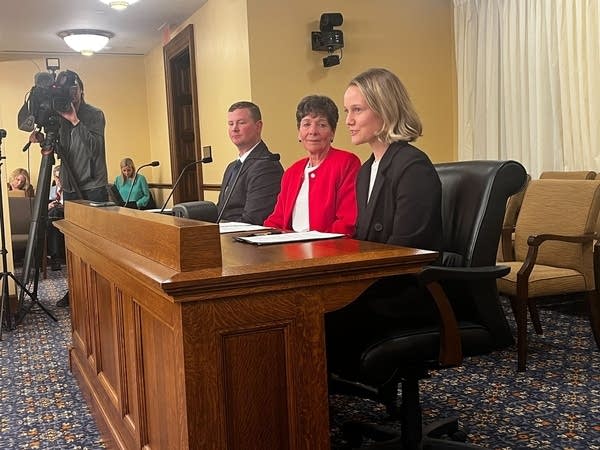
Hannah LoPresto, a former student at Eagan High School who’s testified in support of the bill at the Capitol, cited her own experience with a band teacher who, according to an investigative police report, had a “pattern of predatory grooming behaviors … with numerous students” going back a decade in two school districts.
She described it as a feeling of deep confusion that leaves victims detached and trapped.
“It’s this whole other world you live in that's separate from your own, where they convince you that all of these things are true that aren’t true. And it’s what slowly pulls you away from your friends and family and support network,” LoPresto said.
‘The environment that we’re in’
Lopresto, Rivera, Hudson and other advocates and experts agree that it’s important for people to understand what grooming is, but they say actually preventing grooming and abuse has less to do with being able to recognize the manipulation, and more to do with creating the conditions that make grooming and abuse impossible.
Rivera believes abuse prevention in schools should be approached the same way institutions prevent fires.
“The restaurant industry has food inspectors. We have fire inspectors that go in and look at the environment to determine, is this a safe environment. Schools should be audited for safeguarding the same way that we are auditing them for fire safety,” Rivera said.
At Safe Sport, educating people on what grooming looks like is key. The organization also has a process for investigating accusations of abuse, maintains a database of sports professionals who have violated the organization’s code of conduct and does regular audits of its registered members to ensure safety standards are being upheld.
“It’s less about spotting the specific behaviors and more about looking at the environment that we're in,” Rivera said. “It’s important to be able to know how to put out a fire, but we spend a lot of energy also looking at what kinds of environments are combustible, and how do we need to maintain those environments.”
Hudson, the Minnesota Children’s physician, sees the Safe Sport model as an answer. He wants schools to implement easily identifiable safety standards such as restricting the types of communications between staff and students” and rules that define “what activities need to be easily interruptible and observable,” said Hudson.
“If you’re seeing that happening, that needs to be reported, and needs to be reported not just to your principal, right?” Hudson explained. “And then, why not make everybody aware of those rules? Why not have signs up around the schools so the kids know those rules, and that the parents know those rules and stuff.”
‘Long past time’
The vast majority of child sex abuse that happens does not occur in a school setting. Still, child abuse at the hands of an educator is not outside the norm for American students.
A study published in 2022 found rates of child abuse by educators affected nearly 12 percent of the almost 7,000 students surveyed. The vast majority of abusers were male and academic teachers and the vast majority of students experiencing the misconduct were female. Only 4 percent of those abused reported their experiences.
The anti-grooming legislation currently working its way through the Minnesota Legislature has many of the hallmarks experts say are necessary to prevent grooming in schools.
If approved, the bill would make grooming a felony and an offense that triggers the automatic revocation of a teaching license in Minnesota.
It would require police to notify the state teacher licensing board when an educator is convicted of grooming or other crimes triggering the automatic revocation of teaching licenses.
The law would also require the Minnesota Department of Education to develop training on grooming for mandatory reporters and prohibit school employees and volunteers from being alone with students during field trips.
MDE would also be allowed to investigate allegations of student maltreatment older than three years, a current provision that hamstrung the department’s ability to investigate LoPresto’s allegations.
While the bill doesn’t cover all the bases experts say are necessary to prevent grooming, they say it covers important ground.
“It's important to have it on the books,” said Elizabeth Jeglic, a professor of psychology at the John Jay College of Criminal Justice in New York who recently worked with lawmakers in Vermont to pass what she considers model anti-grooming legislation.
“Everybody now has to do criminal records checks. And so if you run it, and then there's a charge for grooming, that's already a red flag to you that something has happened,” she said.
For LoPresto, it’s important that Minnesota’s criminal code address not just assault, but the process of grooming itself, which she believes should be a felony.
“Often, when I share that I was groomed and sexually assaulted, most people focus in on the sexual assaults as being the most horrific and impactful, LoPresto told lawmakers. “But for me, the five-plus years of grooming were even more harmful to my long-term health and well-being.”
For now, Minnesota lawmakers on both sides of the aisle seem to be in agreement that passing legislation to prevent grooming is a priority.
At a recent Senate hearing, Sen. Mary Kunesh, DFL-New Brighton, thanked lawmakers and testifiers for working to pass anti-grooming legislation.
“It’s long past time for us to have addressed this issue of grooming, not just in our school setting, but … it extends into day care and child care,” she said.
“Grooming is certainly a serious, serious offense, and there are many people that have gotten away with it mostly because the legal framework has not been there,” she added. “This really lays that framework for that.”