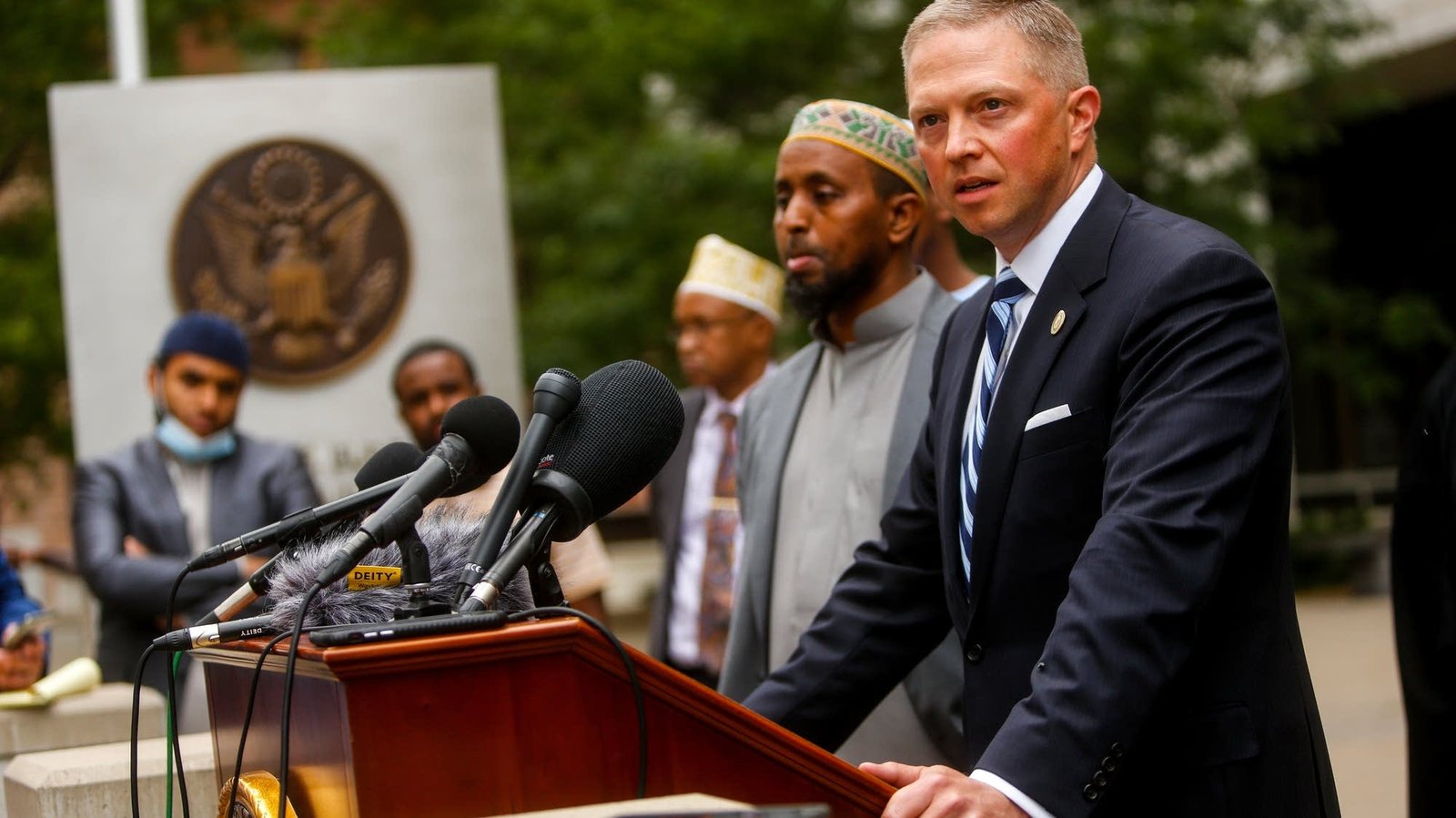

There were two winners out of the August primary: Former federal prosecutor and Acting U.S. Attorney for Minnesota Anders Folk and State Rep. Cedrick Frazier.
It sets up a November matchup for the seat being vacated by Mary Moriarty.
Minnesota Now host Nina Moini spoke with both candidates.
You can hear the conversation with Frazier, Thursday at noon on Minnesota Now.
The conversation with Folk below is edited for clarity. Use the audio player above to listen to the full conversation.
Why did you decide this was the right time for you to pursue this position?
I was really feeling like the county attorney’s office just needed a change of direction. And that the county attorney’s office, which is our largest public law office in Minnesota and the largest office of prosecutors in Minnesota, could really use somebody with that background as a prosecutor and in criminal justice doing this work. So, it was important to me.
How do you believe your experience as a U.S. Attorney and other roles that you’ve held would help you in this role?
For starters, having done hundreds of cases, investigations, charging decisions, trying cases —that’s really the bread and butter of the criminal side of the Hennepin County Attorney’s office.
So, having that kind of lived experience, I think, is really critical in terms of driving an understanding for strategy, decision-making, and just how to run an office like this. In addition to that work, I’ve had the benefit of leading a public law office like the U.S. Attorney’s Office here in Minnesota.
These are hard jobs. They’re often very public jobs and they’re jobs that really critically impact the day-to-day experience so many people in the county will have with the public safety system.
So, I think that experience is all really critical to setting the right strategy and to understanding how to lead an office that’s as big and as important as our county attorney’s office.
One of your top priorities you’ve mentioned is seeking accountability for the actions of federal agents during this operation. How big of a priority is that for you? What steps are you planning to take?
It’s a significant priority and I think accountability is a critical thing for everybody impacted by the county attorney’s office. Whether you’re a federal agent who broke Minnesota law during Operation Metro Surge, or a fraudster, or a violent criminal — accountability to me needs to run in every direction.
But, as it relates to Operation Metro Surge and these federal agents who violated Minnesota law, I’ve talked a lot about creating a federal prosecution task force to ensure accountability.
And your readers and your listeners may be asking why would we need a federal prosecution task force for these cases charged in Hennepin County? The answer is, all of these cases are going to end up in federal court so that federal subject matter expertise I think is going to be critical here, both in terms of understanding how to do investigations but prosecutions that are going to actually have the highest likelihood of success in federal court.
These are cases we’ve never done here in Minnesota. These are going to be cases we’re doing for the first time in the history of this state. And, I think it just really speaks to how critical it is to have that deep experience doing federal criminal prosecution work because that’s where these cases are all going to end up.
Do you see circumstances under which the Hennepin County Attorney’s Office should cooperate with federal immigration authorities?
No, the Hennepin County Attorney’s office is not in the business of doing immigration enforcement. This is an office that does state criminal level offenses, and it needs to be focused like a laser on that work.
To me, the core priorities of that office all need to revolve around what is increasing our public safety. So, the violent and repeat offenders of the world, folks who are fraudsters, folks who are making our communities less safe.
That’s where the office’s priorities need to be and it’s enforcing state law to ensure that what we do makes us safer as a community.
You’ve stated you’ll focus on reform measures like expungements, diversion programs, restorative justice. How would you assess when someone should be prosecuted aggressively versus perhaps diverted to an alternative supportive program.
When we talk about the criminal justice system, it’s really a spectrum that, to me, involves both compassion and consequence. And where I think experienced prosecutors can really do the most good is by ensuring that the right cases are handled the right way, whether it’s a case that requires more compassion or more consequence.
Look, violent and repeat offenders are the folks I think that require a response that is going to ensure public safety, and that’s the type of thing that usually involves consequence and getting them off the streets.
But when we’re talking about folks who are suffering from mental health issues, from addiction issues — and those two often go hand in hand — those are often the cases that require more of a compassionate lens and more of a compassionate approach.
Oftentimes, involving really more public health rather than criminal justice responses. And I think, I’m committed to and have spent my career really working hard to make sure we get the right outcomes for the right people who are in the criminal justice system.
It can be difficult for people to see young people committing crimes, particularly violent crimes. Where do you draw the line between intervention and accountability. What consequences should there be for a young person who commits a serious or violent offense?
Well, again, I think this is one of those areas where, if we’re talking about violent and repeat offenders who are juveniles, there does need to be a consequence. And, it’s not just to protect the community, but really also oftentimes to protect the juvenile him or herself.
I mean, these are often people who are in need of intervention and the kind of intervention and consequence that can come through the court system and through an appropriately tailored sentence to that criminal act.
Nobody wants to see kids in jail. I’m a parent. I’ve got four kids. The idea of putting kids in jail, locking them up, and throwing away the key obviously doesn’t feel good to anybody. It’s not. It should never be our goal.
Our goal should always be to treat kids compassionately and get them back into their homes when it’s safe for the kid and for their families. But look, if we’re talking about violent, repeat offenses, premeditated crimes of violence — there has to be a consequence. And in those rare cases, that consequence is going to need to involve getting those kids out of the streets.
What from current Hennepin County Attorney Mary Moriarty’s approach to the job will you continue, if elected?
I want to be very clear. I mean, I am running, in part, to change the direction of that office and to really be an innovative and forward-looking prosecutor who brings to bear a mindset of public safety first. So, there are going to be significant changes.
But, I think Mary deserves credit for moving to ensure accountability in the Operation Metro Surge space. I think she deserves credit for taking good care of many of her employees in terms of ensuring their pay and their benefits are consistent with the great work they do for our community.
And, I think you can expect to see me employ that same kind of approach, where I want to make sure all the employees of the Hennepin County Attorney's office are being treated in a way that really reflects their contribution and their sacrifice to the community.
What would you change to your point about Moriarty’s approach?
I think, first of all, you can expect to see from me a real focus on ensuring that violent and repeat offenders are a priority for investigation and prosecution. I think they put our public safety at risk, and that is going to be a significant change — both in terms of strategy and action.
I think you can also expect to see a very direct focus on team building across the county in terms of all of our public safety stakeholders. I’m excited at the opportunity to work with our law enforcement officials, our educators, our faith leaders and our community leaders to drive a strategy that’s really going to put public safety at the forefront of the mission of the office. I think that’s going to be a change in terms of not just tone but also results.
I think there’s also a real need to ensure that our policy and our practice as a county attorney’s office isn’t driven by rhetoric or ideology, but it’s really driven by what is going to work to make us all safer as a community.
I think the answer to that question is going to come from again working with all these great stakeholders, whether it’s our educators, whether it’s our community leaders, whether it’s our faith leaders, whether it’s law enforcement — getting all of those folks together to really help drive strategy.
The relationship between Moriarty and the previous Minneapolis police chief Brian O’Hara was fraught. With O’Hara resigning now, though, there will eventually be a new MPD Chief you would be working with. How will you approach that relationship or partnership?
I’ll approach the relationship the way I’ve always approached relationships with public safety professionals, whether they’re law enforcement, whether they’re judges, probation officers, defense lawyers, community leaders — and that is mutual respect and an approach that puts mutual accountability at the front of the relationship.
I want to be a good partner to anybody in law enforcement, to anybody in our public safety system, to our our community leaders, and I will be accountable to them. But I will also expect them to be accountable to me.
It’s going to be a relationship that’s going to be based on mutual respect, mutual accountability, and constant communication to ensure that we have a partnership.
What actions will you take to address this ongoing situation of overdoses and drug-related deaths, especially linked to fentanyl?
Fentanyl, drug-related overdoses and accidental deaths are just a real issue for us. It’s one of these issues that really is the intersection of a public health crisis, addiction and often mental health, but also a public safety crisis.
So, to me, there’s kind of two real issues here. One is ensuring that those folks who are preying on our addicted community members are being held accountable. That there’s a significant consequence to get them off the streets because these are folks who are selling this deadly product, fentanyl and other synthetic opioids that are killing people.
But they’re often also doing it using violence. The incidents of violent crime, gun crime, with fentanyl trafficking and synthetic opioid trafficking is a real issue. So, there’s going to have to be a significant enforcement strategy for dealing with those folks.
Then, for the folks who are suffering from addiction, some of them should be handled through a public health response, but there’s going to also be a need for, in some cases, using the criminal justice system to help disrupt, oftentimes, what can be really devastating addiction and the consequences of addiction.
But it’s that combination of public health and criminal justice where I think we’re going to need to ensure that the folks who are taking advantage of our addicted community members are being held accountable is where we’re going to start.
Subscribe to the Minnesota Now podcast on Apple Podcasts, Spotify or wherever you get your podcasts.