
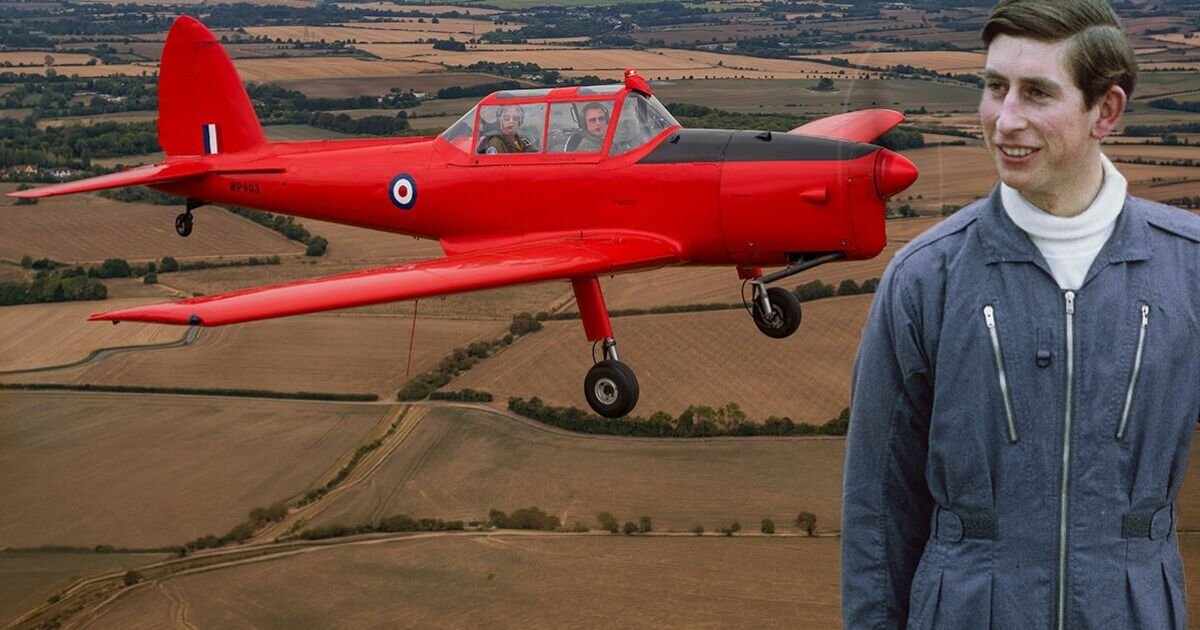

Pilot Bob Brinkley in his Chipmunk that a young Prince Charles took his first solo flight in (Image: Oliver Stevenson)
The cockpit is surprisingly narrow. As I lower myself into the front seat and pull the harness tight across my shoulders and lap, it occurs to me that I’m sitting in the place occupied by a young Prince Charles more than half a century ago.
Despite the years in between, the view over the long nose is unchanged. The smell of oil and ageing leather is probably much the same, too. On January 14, 1969, after 14 hours and 30 minutes of instruction, the future King climbed into this very de Havilland Chipmunk at RAF Bassingbourn for his first solo flight.
The occasion almost never happened there. Charles had been training elsewhere but poor weather forced a move to Bassingbourn, where conditions were suitable for the milestone flight. His instructor, Squadron Leader Philip Pinney of the Central Flying School, had judged him ready. The rear cockpit would be empty. The responsibility would be entirely his.
Every pilot remembers their first solo flight. The mixture of excitement, pride and apprehension is universal. For a few brief moments, titles and backgrounds cease to matter. There is only the aircraft, the runway ahead and the knowledge that nobody is coming to help if you get it wrong. Charles went on to complete his Primary Flying Training later that year, accumulating more than 80 hours on the Chipmunk and earning his RAF Preliminary Flying Badge. Yet it is that first solo flight that remains the defining moment for most pilots.

Ben Griffiths sits in the pilot seat of his Chipmunk (Image: Ben Griffiths)
It is certainly the one that resonates with me every time I climb into a Chipmunk.
Eighty years after the aircraft first took to the air, the de Havilland Chipmunk remains one of Britain’s most beloved aeroplanes. More than 1,280 were built, with 735 entering Royal Air Force service.
For generations of Air Cadets, University Air Squadron students and military pilots, it provided a first taste of flight and a firstlesson in responsibility.
Remarkably, the very aircraft King Charles learned to fly on still exists.
Known by its military serial WP903, it remains airworthy and is operated by a group of dedicated owners based at Old Warden in Bedfordshire. Nearly 60 years after carrying the future monarch on his first solo journey, it continues to delight pilots and spectators alike.
One of its owners, airline pilot and military reservist Bob Brinkley, understands the aircraft’s significance better than most.
“All Chipmunks are lovely,” he says. “But there’s just something about 903.” Then he pauses. “It puts a smile on my face every time I fly it. But it also focuses the mind. You’re sitting on the King’s chair.”
The public reaction is remarkable. Whenever WP903 appears at an air show, people seem instinctively drawn towards it. Children point at it. Former Air Cadets stop to share memories. Pilots remember their own first flights.
Bob recalls flying his first display in the aircraft at Shuttleworth, only to find it featured on local BBC television news that evening. On another occasion he flew Philip Pinney himself, allowing the retired instructor to take to the air once more in the aircraft that helped launch a future King’s flying career.
Yet what strikes me most is not how different King Charles’s experience was. It is how similar it was. Because the truth is that thousands of ordinary people learned to fly in exactly the same aircraft.
That became particularly apparent to me while researching a book about the 80th anniversary of the Chipmunk. At an air show earlier this summer, a young father approached me eager to talk. He had spotted a photograph in the book showing three Chipmunks operating from RAF Woodvale in the early 1990s. One of them was WB654, the aircraft I now co-own.
As we talked, he realised there was a good chance he had flown that very aeroplane as an Air Cadet more than 30 years earlier.The aircraft had connected two complete strangers across three decades.

Princes Charles being briefed about the Chipmunk before taking his solo flight (Image: Bettmann Archive)
Later that same day, an elderly gentleman stopped to share another story. He too had flown Chipmunks. His father, meanwhile, had been a Battle of Britain fighter pilot and had delivered the first Spitfire into RAF service with 19 Squadron at RAF Duxford in 1938. He later flew Chipmunks too. Different generations. Different experiences. The same thread running through them all.
That thread helps explain why the Chipmunk still inspires such affection. It was never the fastest aircraft. It was never the most glamorous. What it offered was something more valuable. It taught people how to fly properly.
Modern aircraft are extraordinary machines, packed with sophisticated avionics, automation and digital displays. The Chipmunk belongs to a different era.It communicates through sound, vibration and feel. It rewards concentration and punishes carelessness.
Many pilots regard it as one of the finest training aeroplanes ever built. I have accumulated more than 200 hours on Chipmunks and every flight still feelsspecial. One of the most memorable came last year when I had the opportunity to fly WP903 itself.
Our own aircraft had developed a maintenance problem in the run up to a flyingholiday in the south of France, and I was invited to join friends who were taking the King’s former mount, travelling down there to meet them on an airliner from London Stansted.
Flying WP903 from the gliding club at Fayence took us above the sunlit hills north of Nice. To one side lay the foothills of the Southern Alps. To the other, the Mediterranean stretched away towards Cannes and the Côte d’Azur.
Ahead of us flew another Chipmunk piloted by renowned display pilot Tony De Bruyn. Maintaining formation demanded concentration, but every so often I found myself glancing sideways at the spectacular scenery. It was one of those rare moments when you become acutely aware of how fortunate you are.
I was flying through some of the most beautiful scenery in Europe in an 80-year-old British trainer that had once taught a future King to fly. Looking out across the aircraft’s distinctive Guards Red wings adorned with RAF roundels, it was impossible not to wonder what Prince Charles had seen and felt from the same cockpit.
The answer, I suspect, is exactly what every Chipmunk pilot experiences. A sense of freedom. A sense of responsibility. And the simple joy of flight.
My own first flight in WB654 had been a pre-purchase appraisal between two airfields in rural England. But one of my happiest memories came on the first solo flight after bringing the aircraft home toOld Warden. A photographer happened to capture the moment I landed the red-and-white WB654 while my previous Chipmunk, WD286, waited at the holding point preparing to depart. The image captured a changing of the guard. One chapter closing. Another opening.

Ben Griffiths is the author of Chipmunk at 80 (Image: Ben Griffiths)
The Chipmunk has a habit of creating moments like that. The aircraft’s influence can be found throughout British aviation.
Countless airline captains, military pilots and instructors trace their careers back to their first encounter with the type.
Among them is Bill Perrins, who went on to fly jets and Vulcan bombers during a distinguished RAF career before returning to the aircraft later in life. He once described the Chipmunk as a “mini-Spitfire”, adding that it became and remains his favourite aeroplane.
But perhaps the most important people in the story are not the famous names. They are the instructors. The Squadron Leaders and Flight Lieutenants who introduced nervous teenagers to the sky and quietly shaped careers that would follow. Men such as Philip Pinney, who guided Prince Charles to his first solo flight. Or Mike Neil, a legendary RAF instructor whose influence spread across generations of pilots.
Years after teaching a young student to fly in a Chipmunk, Mike attended a scholarship dinner and approached the newly appointed Officer Commanding of the Battle of Britain Memorial Flight, Ian Smith. “I might know how to do your job,” he joked.
The reply came instantly. “You taught me to fly!” Few compliments could mean more.
Today, two Chipmunks remain in RAF service with the Battle of Britain Memorial Flight, where they are used to teach tailwheel handling to jet fighter pilots preparing to fly Hurricanes and Spitfires. Even now, the aircraft continues to pass on lessons learned by previous generations.
That enduring legacy was visible in May when dozens of Chipmunks gathered at Halfpenny Green Airport near Wolverhampton to celebrate the type’s 80th anniversary.
Twenty-one aircraft took part in a commemorative flypast over Broughton, where many Chipmunks were built, forming the shape of the number 80 in the sky. Owners, former Air Cadets, instructors and enthusiasts travelled from across Britain and Europe to take part.
Some came to celebrate the aircraft. Many came to celebrate the people. The aircraft’s royal story did not end with Charles.
In April 2008, WP903 reappeared at RAF College Cranwell during Prince William’s RAF Wings Graduation Parade, linking two generations of the Royal Family through the same aeroplane.
Back at Old Warden today, WP903 sits quietly beside my own WB654. To most visitors they appear much the same: two small post-war trainers built for a purpose that should perhaps have disappeared decades ago.
Yet one taught a future King to fly. Both helped launch countless aviation careers. And together they remind us that aviation is ultimately about people rather than machines.
Eighty years after its first flight, the Chipmunk’s greatest legacy may not be the aircraft itself, but the generations whose lives began to change the moment its wheels left the ground.
Ben Griffiths is the author of Chipmunk at 80, published to mark the 80th anniversary of the de Havilland Chipmunk (£37.99); out nowfrom chipmunkat80.carrd.co


