
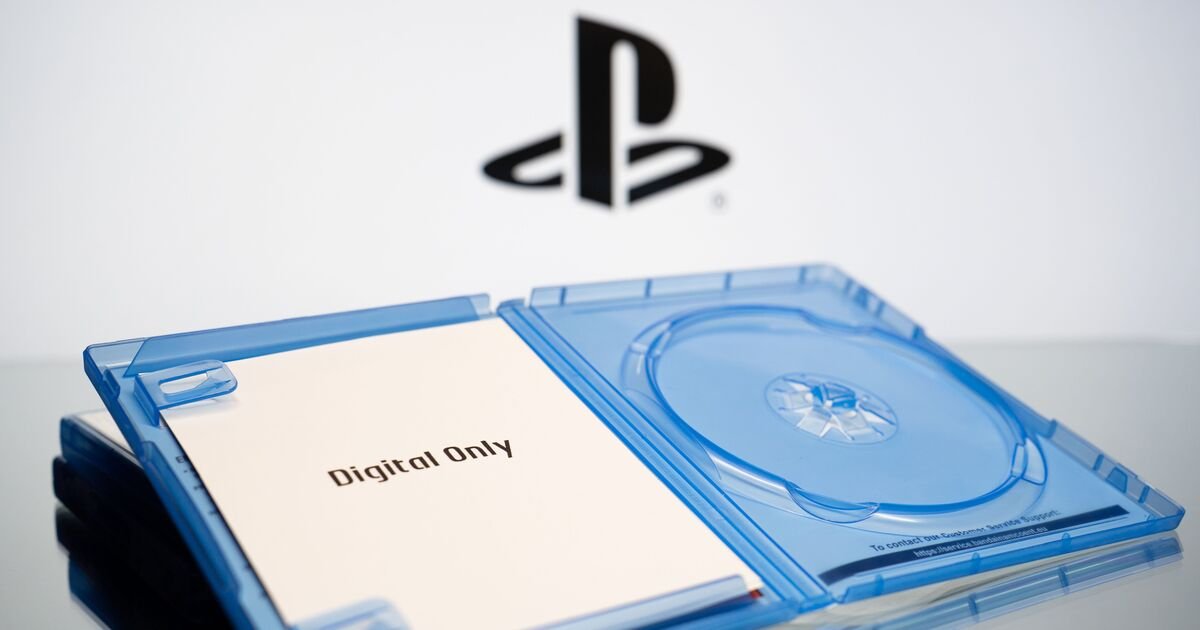

Sony is discontinuing discs from 2028. (Image: Getty Images)
At the start of July, Sony announced the unthinkable. The physical disc that’s long served as the primary medium for game data to be distributed across the world will be discontinued on all PlayStation platforms from January 2028.
You’ll still be able to play older titles on your PlayStation consoles with a disc drive, of course. But any new video game published after that cut off date will no longer see a physical release on a Sony device.
As you’ve likely seen if you’ve spent an ounce of time online this last month, Sony fans haven’t taken to this news kindly. After a short social media hiatus, every PlayStation post now sees its replies flooded with gamers demanding that the company U-turn its decision.
Some claim they’ll take part in a boycott of Sony’s services, voting with their wallets by cancelling their PlayStation Plus subscriptions and unplugging their consoles for a week at the end of August. Others are signing petitions like ‘Don’t Kill the Disc’, which also calls for Sony to rethink its stance on physical media.
Ownership and Preservation
There are two major arguments levied against Sony’s decision: ownership and preservation.
In the case of ownership, the idea is that gamers physically own a game if they have it on disc. It can’t be taken away from them like a digital license can.
This is especially poignant in the case of Sony, which has shown a track record of removing digital licenses from its customer’s accounts in the weeks leading up to this announcement. Over 550 Studio Canal movies and TV shows were removed from Sony’s digital marketplace due to expiring licences with no refunds offered.
As for preservation, it’s argued that it’s much harder to maintain a reliable backup of each and every game that comes out when that data can’t be physically ripped from a source material, such as a disc. For example, if you want to go and play the 1.0 version of Cyberpunk 2077 on PlayStation 4 right now – yes, the completely broken version – you can do that.
You might need to disconnect the console from the internet so it doesn’t automatically update to the latest patch, but the concept is as it always has been since the PlayStation 1 days. You put a disc in, and the console plays the data it reads.
Except discs haven’t really meant ownership for years
The trouble is, both of these arguments fall down when you consider that the way disc distribution has worked for the last few years in gaming is vastly different to the world we grew up playing in.
It’s becoming increasingly rare that a game can be played straight from the disc without requiring some sort of day one patch or an established internet connection. Data from DoesItPlay found that around 34% of tested PS5 games require an update or connection to Sony’s servers to make it playable.
There’s also the vast size of games these days with plenty of newer releases exceeding the 100GB limit of even the most expensive Blu-Ray discs.

Cyberpunk on disc. (Image: Getty Images)
The waters become murkier when you consider live-service games. Consider Diablo 4, which rumours suggest is getting a code-in-the-box release on Nintendo Switch 2 next month. Although Blizzard’s ARPG has what can be considered a single-player campaign, its online features and regular updates since its original 2023 release means the most up to date version is barely recognisable compared to day one.
It’s simply not the case that if we were to dust off a PS5 in twenty years time and load up a disc that it would be the perfectly playable experience we get today if Sony’s servers are offline. Discs have been glorified digital licence keys for a while now, whether we like it or not.
The case for going digital
Throw in the manufacturing and distribution costs of discs in the first place, plus the loss of revenue lost to third party retailers, and it’s easy to see why Sony has come to the conclusion that discs should go the way of the dodo – especially when you look at the way consumer spending habits have changed in the last decade.
According to Sony, around 80% of game sales on its platform are now digital. 20% is still a big chunk, but given this ratio is reversed compared to consumer spending habits a decade ago, it’s easy to see where the industry is trending.
For all the reasons I listed earlier, discs actually provide very little benefit to consumers these days, other than being able to be traded second hand.
Despite the backlash, Sony says that it will ‘cautiously’ continue its plan to discontinue discs in 2028.
Maybe we’re fighting the wrong battle
While I agree with the vast majority of the sentiment behind gamer’s reasons to keep physical media alive, I also believe that the whole scenario has opened everyone’s eyes to just how few consumer rights we have when it comes to digital goods. Given Sony is unlikely to reverse course, surely it now remains more lucrative to campaign for better rights?
In fact, this is something that’s been going on in the background way before Sony brought this whole conversation to light.
The Stop Killing Games consumer rights movement has been ongoing in the EU since 2024, with the aim of preventing developers and publishers from leaving online games in an unplayable state after their servers shut down. While the movement has largely been dismissed by the European Commission so far, its members aren’t backing down and continue to campaign for better digital consumer rights in the EU.

GTA 6 will be a code in the box at launch with no disc. (Image: Rockstar Games)
Meanwhile, another movement in the UK is filing a lawsuit against Sony for allegedly infringing on competition law. The ‘PlayStation: You Owe Us’ claims that Sony has been overcharging its customers for games since 2016 as there is no alternative digital storefront to choose from on PS4 and PS5 consoles.
“Essentially, since at least 19 August 2016, we believe that Sony has been exploiting its UK customers, by charging them too much for PlayStation digital games and in-game content via its control over the entire PlayStation ecosystem,” reads the website’s FAQs. “We say this is a breach of competition law.”
These campaign movements are not insignificant, and will no doubt see more traction now that gamers are waking up to the digital reality of an all digital future. After all, we do know that such a thing can work – it’s how PC gamers have operated for the best part of two decades without really batting an eye.
The PC gaming blueprint
That’s largely down to the sheer goodwill of the owner of Steam, Valve, which is far and away the largest digital marketplace and distributor of games on the platform. Despite being a billion dollar company, Valve is largely considered the ‘good guy’ of video game businesses, regularly running huge discounts on its platform and upholding a very robust refund scheme.
PC gamers can request a no questions asked refund on games they’ve played less than two hours of within two weeks or purchasing. More recently, Valve issued a refund to one Battlefield 6 gamer with over 400 hours after they claimed the game had changed so substantially since launch. EA had removed the staple Rush gamemode as part of its rotating playlists.
It also helps that the PC platform allows for healthy competition. While Steam remains the popular choice, you aren’t locked in with Valve as options like the Epic Games Store and GOG exist, as well as launchers directly run by publishers such as Ubisoft, EA and Activision Blizzard.

Steam is PC gaming’s most popular storefront. (Image: Getty Images)
There’s also the mysterious case of Valve’s apparent monopoly on the PC gaming market. While there’s the illusion of choice on PC, Valve’s ecosystem is so widely beloved that I know gamers who will pay money to play a game on Steam versus playing it for free on the Epic Games Store.
With so much power in its hands, Valve has the opportunity to nickel and dime its customers if it wanted to in pursuit of infinite growth. It’s not entirely clear why Valve doesn’t already do this, but I imagine it being privately owned and not at the beck and call of shareholders likely has something to do with it.
Sony is not in that position, with its publicly traded nature serving its shareholders before its customers. In order for an all digital future to work, it realistically needs to add support for additional digital marketplaces – and that’s unlikely to happen unless it’s forced to by law, as we’ve seen before.
How regulation can move the needle
Fortnite gamers will no doubt remember the very high profile spat between Epic Games and Apple when the latter removed Fortnite from the iOS App Store. This was in dispute over Epic Games bypassing Apple’s in-app payment system, letting players buy V-Bucks more cheaply and dodging Apple’s cut, in deliberate violation of App Store rules.
The end result was that Epic Games took Apple to court in the US, and while Epic lost on most of its antitrust claims, the court did rule that Apple couldn’t stop developers from steering users to outside payment options. Separately, EU lawmakers passed the Digital Markets Act, which forced Apple to allow iPhone and iPad owners to install apps via third parties if they so wished, paving the way for Fortnite’s return in Europe.
Ultimately, this was a win for consumers.
What about the second hand market?
Of course, all of these solutions don’t solve the other major issue with the eradication of discs – the second hand market.
The likes of CEX are very likely to be eradicated from the highstreet as we know it with physical media becoming less and less prevalent. In a lot of cases, this stands to raise the barrier to entry on the hobby – I have fond memories of saving up my paper round wages to spend on second hand games in Grainger Games as a kid, and it was how I afforded to start buying my own games in the first place.

CEX is the UK’s leading second hand gaming store. (Image: Getty Images)
The good news is that Xbox appears to be working on a solution to this problem. According to The Verge, Microsoft is currently looking at a way for physical games to be turned into digital license keys that can be transferred when the disc is re-registered to another Xbox account.
It sounds similar to how Nintendo’s Virtual Game Cards work in practice, and it could be a brilliant workaround to the issue of digital ownership in an all digital future. Sony discs don’t currently have the unique identifiers required to make this system work right now, but it’s not impossible to conceive of a digital process where gamers can gift and trade their digital library to other PlayStation users.
It’s not a perfect fix, of course. You’re still ultimately trusting a corporation to keep the lights on for whatever system tracks these transfers, and given Sony’s track record, I’d be lying if I said I fully trust any of these companies to prioritise consumer goodwill over shareholder returns in perpetuity.
That said, it would be a step in the right direction – a small tip of the balance back towards consumers, rather than the corporations our purchases keep feeding.
That’s really the crux of all this. Sony’s choices here are ones made by a company that’s decided the convenience of an all-digital future is worth more to them than the trust of the people actually buying into their ecosystem.
If Sony’s dead set on having its way, fine – but consumers shouldn’t just roll over. Surely it’s worth campaigning for better rights as the industry moves with the times, rather than clinging to outdated data delivery methods that clearly have the writing on the wall?


