
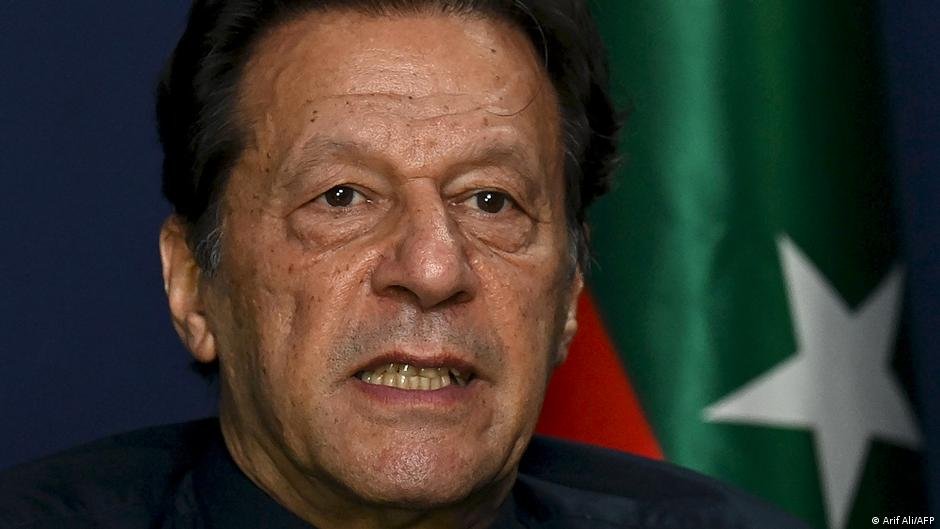
Pakistan’s Supreme Court on Tuesday ordered jailed former Prime Minister Imran Khan to be shifted to a private hospital after Khan’s family and political supporters repeatedly raised concerns about the 73-year-old’s deteriorating health in Rawalpindi’s Adiala jail.
The founder of the opposition party Pakistan Tehreek-e-Insaf (PTI) has been imprisoned since August 2023 and is currently serving a 14-year sentence on corruption charges he says are politically motivated.
The former prime minister was ousted in a parliamentary no-confidence vote in April 2022. Khan and his supporters say Pakistan’s influential military is trying to keep him out of politics, an allegation the military has denied.
Despite remaining behind bars, Khan remains politically popular. After a crackdown on the PTI following Khan’s arrest, the candidates backed by him performed strongly in the February 2024 election.
“Three years in prison have not removed Khan from Pakistani politics. He remains PTI’s biggest political asset, but the party’s reliance on him has also exposed weaknesses in its leadership and organization,” Raza Rumi, a US-based Pakistani political analyst, told DW.
Dousing speculation of new deal for Khan
The transfer of Khan to the Shifa International Hospital in Islamabad for medical assessment has added a new dimension to the debate over his future and the possibility of political negotiations.
However, Khan’s adviser Sayed Zulfi Bukhari rejected speculation that the court decision was the result of any political deal with the government.
“There is no deal between Imran Khan and anyone. This is the Supreme Court’s decision, which is very much welcomed,” Bukhari said.
Pakistan’s Law Minister Azam Nazeer Tarar said in a video statement on Tuesday night that the government would challenge the Supreme Court order, claiming it was unlawful.
The minister said a convicted prisoner must be treated inside the jail or at a public hospital according to law, adding that he was requesting Khan’s medical tests be carried out at a government hospital instead of a private facility.
“Legally, Khan has not been granted bail nor have his convictions been suspended. He will remain a prisoner, and the hospital executive ward shall serve as a sub-jail. Unfortunately, most ordinary prisoners with far more serious ailments are never allowed such facilities by the courts,” Osama Malik, a legal expert, told DW.
Pakistan’s Minister of State for Interior, Talal Chaudhry, told DW that “Khan’s cases will be decided by the courts.”
Khan’s health problems carry ‘major political consequences’
PTI’s Bukhari told DW that Khan “hasn’t been receiving the right medical care in prison.”
“That is why it has got to this stage. He has been kept in complete solitude, which has deteriorated his health,” said Bukhari.
The PTI party has said Khan is suffering from various health conditions, including poor eyesight, fluctuations in blood pressure and anxiety linked to restricted contact with his family, and has been unable to access specialist medical care.
Some analysts think the health concerns are now serious enough to have prompted Supreme Court intervention.
“Beyond the medical issues, this is also about trust. The PTI and Khan’s family have repeatedly questioned his access to doctors and the transparency of his treatment,” said analyst Rumi.
“After three years in prison, and given his age, any deterioration in his health carries major political consequences. The state, therefore, has every reason to ensure credible and transparent medical care,” he added.
The court has also ordered a medical board, including Khan’s sister, Dr. Uzma Khan, and personal physician Dr. Faisal Sultan, to oversee Khan’s treatment.
What future for Khan and his PTI party?
Khan’s continued imprisonment has tested the PTI’s ability to maintain its political strength, and the party’s future will depend on whether it can maintain support without the direct political presence of its figurehead.
“Khan’s political future does not look bright; he will have to compromise his political future. He will remain in jail, and even if his PTI party comes to power in the future, Khan will not be part of the government,” Qamar Cheema, a political analyst, told DW.
At the same time, Khan’s continued popularity makes it difficult for authorities to remove him completely from the political equation in Pakistan.
“For the state, the dilemma remains: keeping Khan imprisoned has not neutralized his influence, while releasing him without a broader settlement could revive the confrontation,” said Rumi.
Rumi added that any lasting political settlement with Khan would likely require an understanding with the military establishment, which remains a key stakeholder in Pakistan.
“Such a deal could involve legal relief for Khan, greater political space for PTI, and eventually his release, in return for PTI easing its confrontation with the military and pursuing a negotiated political process. But deep mistrust remains a major obstacle, while Khan’s reluctance to compromise limits the prospects for a settlement,” he said.
Analyst Cheema said he doesn’t think there is any possibility of a deal between the government and Khan.
“This was a genuine understanding in the Supreme Court that he should have been given proper health care,” he said.
Edited by: Wesley Rahn


