
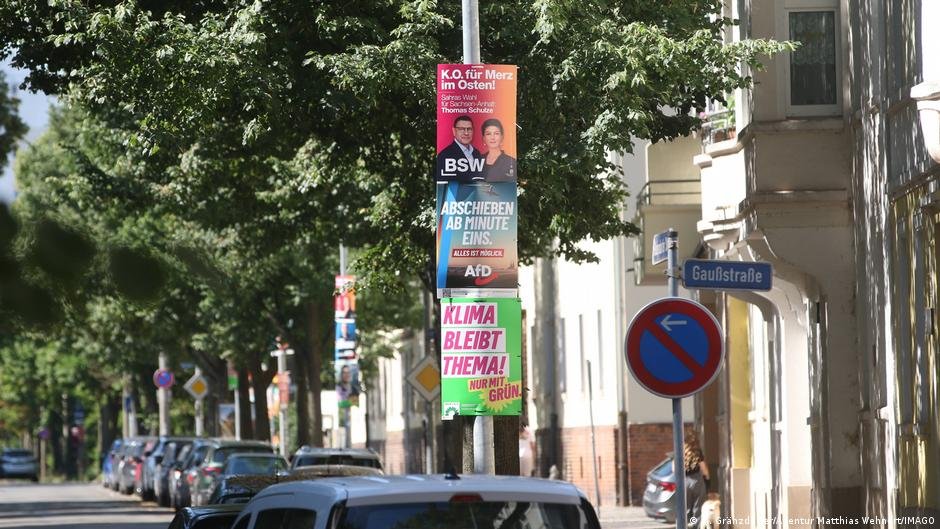
The Saxony-Anhalt state election on September 6 could make history. For the first time, the far-right Alternative for Germany (AfD) could become the strongest party in a German state by winning the vote.
The AfD is currently leading the polls at over 40%, far ahead of the center-right Christian Democrats (CDU) of Chancellor Friedrich Merz at around 24%.
The AfD advocates a restrictive immigration policy centered on sharply reducing migration, increasing deportations and promoting what it calls “remigration,” while also emphasizing national sovereignty, cultural identity and traditional family values.
Many people with a migration background consider the Saxony-Alhalt election to be more than a political choice of direction.
Awet Tesfaiesus, a member of the Bundestag for the Greens who was born in Eritrea, emphasizes this point. She said the election is “not just any election for Black people and other people who experience racism.”
“When racist and ethno-nationalist positions become stronger, the question for them becomes very concrete: How safe can I feel here, and will I be recognized as a natural part of this society?” Tesfaiesus told DW.
Karamba Diaby knows these concerns well. The former center-left Social Democratic Party (SPD) member of the Bundestag, who was born in Senegal and has lived in Saxony-Anhalt for decades, told DW about growing uncertainty.
“When I am in school classes or visiting migrant organizations, I keep hearing the question, especially from younger people: ‘Can we continue to stay in this country?’”
“Of course you can stay here,” he said. “I am against painting the devil on the wall and saying I would leave my state if such a majority came to power. That would be the last thing we could do.”
Why the AfD is being discussed so much
In conversations about the state election in Saxony-Anhalt, no party’s name comes up as often as that of the AfD.
The AfD election program calls for a “deportation and remigration offensive” but does not clearly define remigration. The term is politically contested and is generally associated with proposals aimed at increasing the departure of certain categories of migrants and foreign nationals, alongside deportations of people without a legal right to remain.
The AfD’s manifesto uses the word remigration not only regarding immigrants. It also proposes incentives to encourage German skilled workers who emigrated abroad to return to Germany.
Many people with migration backgrounds have reported feelings of uncertainty.
Syrian-born Batoul Nayouf from the Saxony-Anhalt State Network of Migrant Organizations (LAMSA) described the mood in a report for public broadcaster MDR with the words: “We are sitting on packed suitcases.”
But Amidou Traore does not agree with that assessment. The integration advisor and local politician with roots in Cote d’Ivoire, who is based in the Saxony-Anhalt city of Magdeburg, is “completely relaxed,” he told DW. “Everyone knows that the AfD is a party of hate and incitement, and those like me who oppose it are trying to stay calm.”
‘We also belong in this country’
The share of foreign nationals in Saxony-Anhalt, at 7.9%, is far below the national average.
But like Traore and Diaby, many members of the African community in Saxony-Anhalt are actively involved in public life. In associations, businesses, church congregations, and local councils, they see an opportunity to make their interests more visible.
Their issues include employment, education, and the debate over migration. Many of these areas are closely interconnected. The question of equal opportunity plays a role in the education system just as much as the way society deals with diversity.
By the end of 2025, around 193,000 people with foreign citizenship were living in the state, and about 10% of the foreign population came from African countries.
Over the past ten years, the number of people with an international background has nearly doubled. International students, care workers, scientists, and entrepreneurs now contribute to the state’s economic development in many sectors.
“Black people and people with a migration background belong to this country,” Green politician Tesfaiesus emphasized in her statement to DW. “Their rights and their safety are not up for debate.”
At the same time, many Black people and people of African descent report discrimination in everyday life.
Afrozensus, a study on the lived realities of Black people in Germany, shows that experiences of racism are part of daily life for many, whether in public authorities, educational institutions, or public spaces.
For people such as Karamba Diaby, Awet Tesfaiesus, and Amidou Traore, one thing is clear: the future of the state will not be determined by election results alone, but by the people who stay, get involved, and take responsibility. That will remain true even after a possible AfD election victory.
“The election matters and is decisive,” Traore emphasized. “We have to cast our votes. If the AfD comes out on top, then it has earned the victory. And then we will see how life in Saxony-Anhalt is shaped. But we should try to avoid that.”
This article has been adapted from German.


