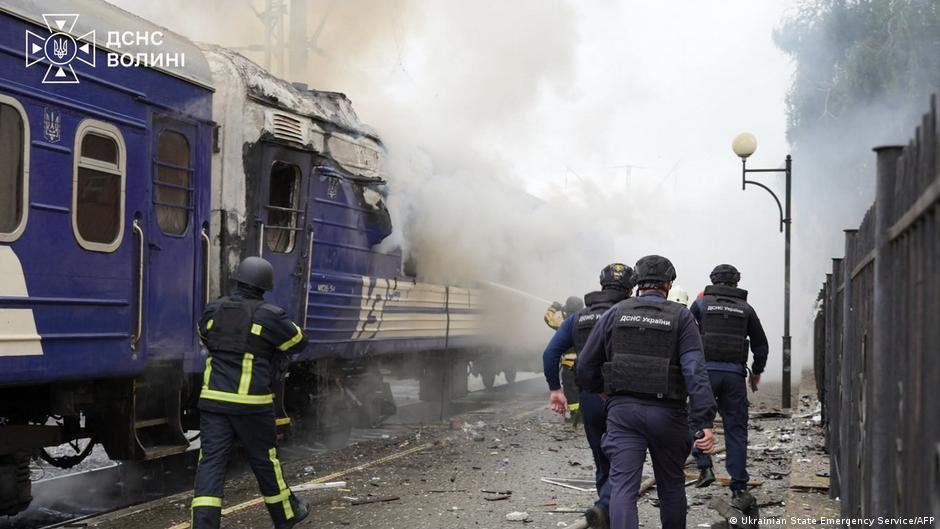
Recent months have seen a rise in Russian drone attacks on locomotives, stations, and infrastructure. More than 1,600 attacks were reported in the first eight months of 2026, according to Oleh Holovashchenko from Ukrzaliznytsia, the state rail operator.
On September 16, a train traveling between the capital Kyiv and Mykolaiv in southern Ukraine was struck by a Russian drone. The day before, another train in the Volhynia region was attacked near the Polish border.
Two days earlier, a drone had struck the locomotive of a passenger train at the Yahodyn border crossing, just two kilometers (1.2 miles) from Polish territory. Nobody was injured, as Ukrzaliznytsia’s monitoring system had previously detected the drone and the train had been evacuated about 15 minutes before the attack. At the time, CIA Director David Petraeus was on another train at the same station.
A separate train carrying several former European leaders, including ex-British Prime Minister Boris Johnson and security advisers had stopped at the station earlier the same day. The Ukrainian authorities believe that this diplomatic train was the drone’s actual target, but the train departed earlier than scheduled.
‘Putin’s terror’ against Ukrainian logistics
Russia has damaged or destroyed more than 500 Ukrainian locomotives since its full-scale invasion of Ukrainebegan in 2022. More than half of these attacks happened this year, according to a post on the social media platform X by Ukrainian Foreign Minister Andrii Sybiha. He said that part of “Putin’s terror” was to destabilize Ukraine’s logistics system.
The minister called on international partners to tighten sanctions against Russia further and to provide financial assistance to the Ukrainian government so that it can procure more locomotives that are compatible with Ukraine’s Soviet-era broad-gauge (1,520 millimeters or almost 5 feet).
“Ukraine’s railway keeps the country moving,” Sybiha said. “It enables the rapid evacuation of civilians from frontline areas, transports essential cargo, and keeps grain and other critical goods moving across the country.”
Russia was specifically targeting locomotives because they were ideal from a technical point of view, said Vasyl Shevchenko, a former Ukrainian deputy transport minister. “A locomotive’s thermal signature is very large, and almost impossible to miss,” he told DW. “The impact of a strike can be devastating, because 50 kilograms (110 pounds) of explosives in a diesel locomotive can cause several metric tons of fuel to detonate and completely destroy it. A strike on an electric locomotive will cause a fire that can paralyze an entire stretch of track. That’s why they are targeting areas where the loss of a single train can bring traffic to a standstill.”
Shevchenko also pointed out that locomotives could not be replaced immediately but had to be ordered in advance and this could take years. Ukrzaliznytsia says that negotiations are underway with various international partners and a contract has already been signed with the French company Alstom. These locomotives are scheduled to start arriving next year.
In the meantime, trains are also being repaired. “While our top priorities used to be saving on costs, providing comfort to the train crew and making sure the trains were attractive, these have changed,” Holovashchenko said. “What is most important today is that the locomotive is technically sound and ready to transport passengers and freight.” But he added that it was difficult to protect trains against Russia’s weapons.
Zelenskyy intensifies protection of critical infrastructure
On September 15, Ukrainian President Volodymyr Zelenskyy held a meeting of the staff of the Supreme Commander-in-Chief to discuss strengthening the protection of critical infrastructure and logistics.
The key issues were contracts for the production of protection systems for critical infrastructure and logistics, but he added that there were plans to expand the electronic warfare component and reorganize the operation of designated mobile fire teams, as well as strengthening air defense lines.
Zelenskyy said that decisions on backup logistics routes in frontline regions were also being made, and he had instructed Ukraine’s Finance Ministry of to find additional funding for the logistics sector.
Ukrzaliznytsia sets up monitoring centers
According to Holovashchenko, Ukrzaliznytsia is also seeking its own answers to the new challenges and there are plans to develop early detection systems. He said that a monitoring center had been established to track the movement of drones and trains all over Ukraine.
The fact that Russia has started to use jet-powered Shahed-type drones, which are much faster than previous models, has made it more difficult and given less time to respond. “We used to wait longer to stop trains so we could evacuate passengers,” Holovashchenko said. “Now, there are more precautionary stops. But in general, we try not to go into areas where there is a potential danger.”
Buses are deployed in areas of particularly high risk and the “train plus bus” concept is being expanded in cooperation with military authorities. Passengers are also being given instructions on how to respond in the event of an alarm and advised to try to get further away from a station than previously.
The most difficult question remains where they should be evacuated to. Holovashchenko said that the monitoring centers had access to maps showing all the shelters along train routes and that dispatchers always tried to stop trains near them, but this was not always possible. He said that train personnel were receiving special psychological support to help passengers.
Ukrzaliznytsia is currently preparing for winter, while working with foundations and other donors to ensure that trains will be heated. Evacuations will be even more difficult as temperatures drop. “This is no easy task. We’re providing blankets, rain jackets, and equipment so that train staff can supply passengers with at least the bare necessities if their train comes to a standstill in the middle of nowhere because of a snowstorm, Holovashchenko said.
This article was originally published in Ukrainian.