
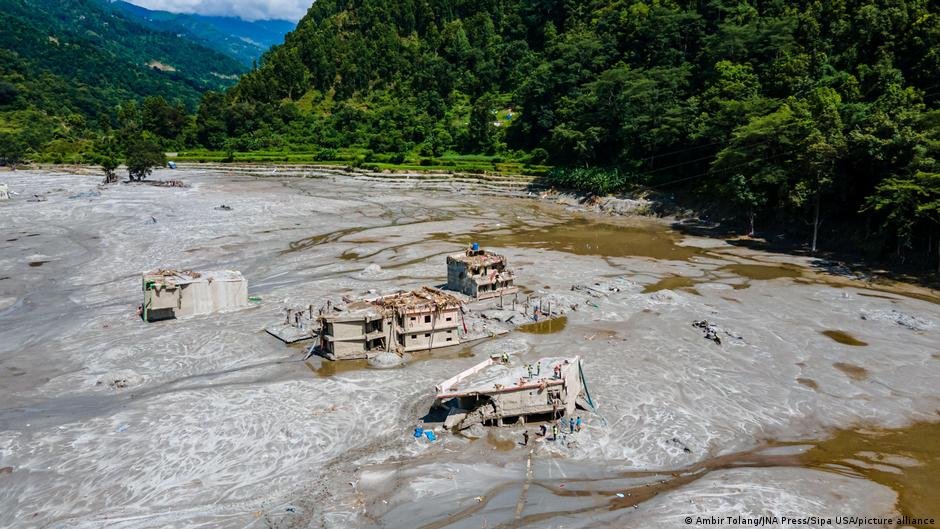
Days after devastating floods swept through Nepal’s Bhotekoshi-Trisuli river basin, the true scale of the disaster is still emerging.
More than 1,250 people have been confirmed dead and almost 4,000 are still missing.
Buildings, bridges, roads and over a dozen hydropower facilities have been destroyed, causing an estimated $2.6 billion (€2.24 billion) in damage to public and private infrastructure, according to the National Disaster Risk Reduction and Management Authority (NDRRMA).
Search and rescue operations for missing people remain underway, with families still hoping for their safe return.
The exact cause of the glacial collapse remains unclear, but experts say climate change is causing glaciers to melt worldwide, increasing the risk of such disasters.
A global responsibility?
For Nepal, the disaster has raised a question that goes beyond rescue and reconstruction.
It’s about climate justice and who should bear the costs and responsibility for such environmental disasters when the Himalayan nation contributes only a tiny fraction of global greenhouse gas emissions yet faces increasingly severe climate-related risks.
Nepal’s Prime Minister Balendra Shah said responding to the catastrophe is a “global responsibility.”
“As we work tirelessly to address the damage caused by this sudden and massive disaster, a deeper question has also emerged: How did this destruction happen to us?” Shah asked while addressing Parliament this week.
“Mitigating and managing its impacts is regarded as a shared responsibility of the international community,” he stressed.
Kathmandu is planning to raise climate justice issues in the upcoming United Nations General Assembly session in New York, where Prime Minister Shah himself is likely to lead the Nepali delegation.
“We will make our case about the impact of climate change and seek global support and moral obligation to tackle it,” Nepal’s Foreign Minister Shisir Khanal told DW. “We will also take the initiative of building a coalition of climate-vulnerable countries to raise our collective concerns.”
Highly vulnerable to climate impacts
Nepal, a largely rural nation of 30 million people, has contributed little to the greenhouse gas emissions driving global warming.
The country accounts for just 0.1% of global greenhouse gas emissions and emits about 0.5 tons of CO₂ per person each year, making it a “negligible contributor to climate change,” according to the World Bank.
But the landlocked Himalayan nation is highly vulnerable to the effects of climate change, with flooding, landslides, glacier-related hazards and other environmental risks threatening lives and livelihoods.
Nepal’s leaders say the country needs long-term international support to adapt to a rapidly changing mountain environment.
The country’s government estimates that implementing adaptation priorities between 2025 and 2035 could require as much as $18 billion to $20 billion. And Kathmandu wants international climate finance to provide most of these funds.
Nepal has spent years arguing in global climate forums that vulnerable mountain countries need greater support for adaptation and resilience.
In December 2009, Nepal held a historic Cabinet meeting at Kala Patthar, near Mount Everest base camp, at an altitude of 17,192 feet, to highlight the threats that climate change and glacial melting pose to Nepal and other mountainous nations.
Bimala Rai Paudyal, a former Nepali foreign minister, said the latest disaster meant “this is an opportune time for us to highlight glacier melting and climate justice issues in international climate forums.”
“Earlier, we were advocating only about climate impacts. Now, we are heavily suffering from it,” she told DW.
Paudyal believes Nepal is well positioned to lead an alliance of vulnerable countries, given its exposure to climate risk as well as its expertise and contribution to the climate justice efforts.
An opportunity for global climate action?
Kathmandu has formally approached the United Nations Framework Convention on Climate Change (UNFCCC)-backed “Loss and Damage Fund” for assistance over the latest floods.
But the fund, set up by the UN in 2025 to aid the impacts of climate change, has not yet begun distributing its limited cash.
The fund also relies on voluntary contributions and lacks legally binding commitments under current international climate agreements, leaving major emitters such as China, India and the US under no direct obligation to compensate for climate change impacts.
Still, some observers and climate advocates believe Nepal can present a strong case for urgent global climate action.
“Nepal can turn this tragedy into an opportunity for global climate action,” Dinesh Paudel, professor of sustainable development at Appalachian State University in North Carolina, told DW. “For which, Nepal needs to build a consensus among national stakeholders and maneuver cautiously, considering geopolitical factors.”
According to him, Kathmandu can create an ethical movement for climate justice by highlighting the recent flood. This could then lead to creating an effective and legally binding mechanism to deal with climate impacts in the future.
Ashok Swain, professor of peace and conflict research at Uppsala University and also UNESCO Chair on International Water Cooperation, shares a similar view.
“Nepal should not be left to pay for a climate crisis it did little to create or for regional non-cooperation over which it has limited influence,” he said. “This is not a question of charity. It is fundamentally a question of climate justice and a fair distribution of responsibility.”
Edited by: Srinivas Mazumdaru


