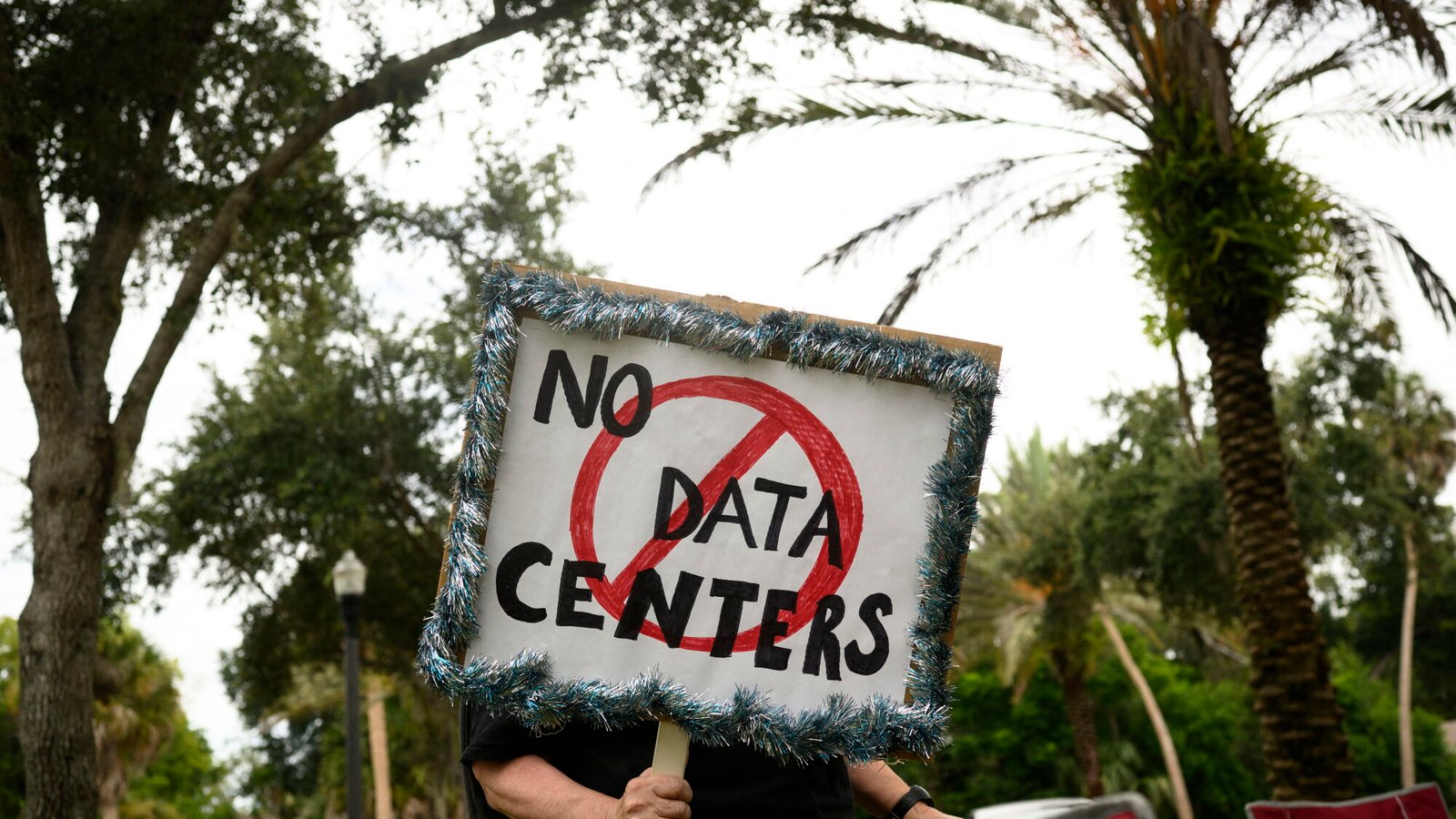

A person holds signs during a nationwide protest against AI data center expansion in New Port Richey, Fla. on July 18.
Thomas Simonetti | AFP via Getty Images
In campaign ads airing everywhere from Georgia to Iowa, Republicans and Democrats are confronting the same enemy: data centers powering the artificial intelligence boom.
An NPR analysis of political advertising data from the firm AdImpact found that since January, campaigns and outside groups have spent more than $45 million on ads mentioning data centers in this year’s gubernatorial, House and Senate races.
The two major parties driving that spending are largely making the same argument: the sprawling facilities get too many tax breaks, drive up electricity bills and need reining in.
From January to August, spending was nearly identical: over $22 million supported Republican candidates and more than $21 million for Democratic candidates, with independents driving the rest. Still, Democrats ran almost twice as many ads as Republicans — 127 compared to 67 — and spread their messaging across more states and races. The ads are clustered in states with competitive races, like Wisconsin and Michigan.
MPR News helps you turn down the noise and build shared understanding. Turn up your support for this public resource and keep trusted journalism accessible to all.
Mentions of data centers have grown from just a handful in ads from January, to 62 in June, more than 110 in July and about 164 in August, as the election draws nearer and the issue continues to heat up.
A June Reuters/Ipsos poll found that 77% of Americans are concerned about data centers raising electricity costs and two-thirds of Democrats and half of Republicans said they’d oppose a data center in their community.
This bipartisan anxiety helps explain why candidates in both parties are talking about the issue. Michael Franz, co-director of the Wesleyan Media Project, which tracks political advertising, said data centers give each side the talking points it wants.
Apart from a chance to talk about affordability, “Democrats can latch on to environmental concerns,” Franz said, adding that for Republicans, criticizing data centers is a way “to go in opposition to big corporations, in opposition to a system that doesn’t care about you.”
Data centers are a unique issue where “MAGA Republicans and liberal Democrats” land in the same place, he said.
The convergence around affordability
Ads from both parties are tying data centers to rising energy costs.
A Believe in Wisconsin PAC ad for Wisconsin’s Democratic gubernatorial nominee David Crowley, which the group spent $634,795 to air in August, promises that Crowley “will lower costs, make housing affordable, stop AI data centers from making your energy bills skyrocket.”
Byron Donalds, Florida’s Republican gubernatorial nominee, casts himself as a check on data centers, by vowing to “protect Florida families and communities from data centers that jack up utility rates and make everything else more expensive,” and “fight for a ratepayer protection plan.” The Friends of Byron Donalds PAC paid over $2.5 million to air the ad.
Similar ads have run in support of Democrat Rob Sand in Iowa and Republican Ty Masterson in Kansas.
A Republican Party operative spoke to NPR about this on condition of anonymity, and said the party is not commenting publicly on data centers because the views within the party vary. They said “The most popular answer that we’ve seen is: We could potentially have data centers as long as they pay for their own energy,” adding that data centers are necessary to win the race against China “and increase jobs in local communities.”
Similarly, Olivia Davis, a spokeswoman for the Democratic Governors Association said data centers are creating deep concerns around affordability and utility costs.
“That’s why it’s being included in paid media,” she said.
Georgia and Ohio: where data centers take center stage
According to data from AdImpact, more than half of the GOP’s spending on ads mentioning data centers has been in Georgia and the state has captured about 30% of total spending on data center ads.
Georgia’s contest for governor is the race that has spent the most on ads mentioning data centers — $12.8 million across nine ads.
Six ads discouraged voters from backing Republican Lt. Gov. Burt Jones who lost the June runoff to healthcare billionaire Rick Jackson. The ads, some of which were run by Georgians for Integrity, a group that has dropped millions attacking Jones since 2025, used data centers as a bogeyman for Jones’ alleged corruption.
In Ohio’s U.S. Senate race, supporters of Democratic nominee Sherrod Brown have spent millions to describe his opponent, Republican Sen. Jon Husted, as the “the face of data centers,” and accuse him of “giving corporations over $2.5 billion in out of control tax breaks and causing electric bills to spike by thousands of dollars.”
Republicans are aware of the shifting tide. In an internal memo obtained by NPR and first reported by Axios, the National Republican Senatorial Committee singled out the Ohio race, called data centers a “sleeper issue for the entire election cycle,” and warned the tech industry that a Husted loss would make politicians nationwide wary of them.
Husted isn’t airing ads on the topic. He championed data centers as Ohio’s lieutenant governor but has since introduced congressional legislation to protect ratepayers from the higher electric rates that data centers can cause.
In an interview with Spectrum News, Husted addressed a seeming shift in his position.
“It’s not really a shift. I was always trying to hold these companies accountable by making them pay local property taxes,” he said, also highlighting his push to require the companies to hire locally. “So this is very consistent for me, holding them accountable.”
A local issue with national attention
The Ohio contest is a rare Senate race with heavy spending on ads mentioning data centers.
According to AdImpact data, gubernatorial races spent the most on such ads, about $32 million, with House races in second place, spending $8 million and Senate races coming in third at roughly $5.3 million.
“The federal government doesn’t really play a role in permitting the construction of new data centers,” said Darrell M. West, a senior fellow at the Brookings Institution’s Center for Technology Innovation and co-editor in chief of TechTank. “Governors are under a lot of pressure to slow the construction of new data centers just based on public opposition to them.”
The issue, however, has spilled beyond gubernatorial races. In some of the country’s marquee Senate contests, candidates such as Texas’s Democratic Senate nominee James Talarico have said that Washington should step in.
The Republican turn against data centers is more striking because experts say that the party has positioned itself as pro-business. West said Republican incumbents and nominees “want to slow down the movement towards data centers because they can see so many of their own voters are opposed.”
That leaves the party at odds with President Trump who has urged states to keep building data centers while admitting that they could “use a little public relations help.”
“Trump seems oblivious to public opinion on a number of fronts,” said West. “Typically, when the public shifts, politicians shift with them. Trump is not doing that on data centers.”
Copyright 2026, NPR