
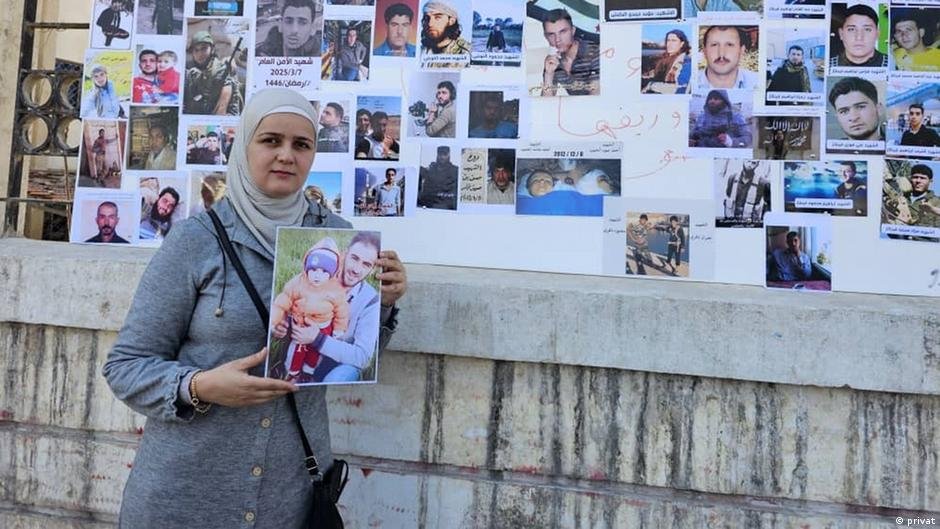
Huda Khayti often finds herself returning to the place where she lost almost everything. Khayti, a Syrian women’s rights activist, survived a 2013 chemical weapons attack on the east Ghouta region by forces of the former Syrian dictator Bashar Assad.
Her brother was killed by the bombs of the Assad regime and its allies. Her women’s center was destroyed along with her home and in 2018, she had to leave her hometown of Douma — a major city in Ghouta — and flee to Idlib, a rebel stronghold in northern Syria.
Today, Khayti regularly visits her hometown, which is about 10 kilometers (about 6 miles) northeast of the country’s capital, Damascus. Since the Assad regime was overthrown in late 2024, Khayti has traveled regularly between Idlib and Douma, where she’s even working on opening a new women’s center.
“Ghouta means so much to me emotionally,” she told DW. But every time she returns there, she is also confronted with remnants of the civil war. “When I’m traveling through the country I see traces of war everywhere, so many houses and so much infrastructure destroyed. So much suffering. So much trauma.”
Almost two years since the overthrow of the Assad regime, Syria has started a process to examine the crimes of the regime in court. In mid-August a Damascus court sentenced Bashar Assad and other high-ranking members of his regime to death in absentia. Assad is currently living in Russia, where he fled after his government was overthrown. Many senior officials are also there or hiding elsewhere.
Among other things, Assad was found guilty of premeditated murder, torture and depriving individuals of their liberty. The court said these were war crimes and crimes against humanity.
“Of course, this conviction of Assad is a good thing,” Khayti said. “Even if it’s only on paper. Bashar Assad may have been convicted but he just continues to live his life in Russia — like so many other Syrian criminals who fled to Russia.”
Justice served in Syria?
The court’s conviction had a big impact in Syria anyway. “The verdict had a lot of echoes by people, they were so happy,” said Lina Chawaf, a Syrian journalist, media expert and researcher at Harvard University’s Center for Middle Eastern Studies. “Many media celebrated the verdict on the statement day as a victory and consider it as part of transitional justice.”
Still, it remains unclear whether there will be any actual punishment following the conviction. Although Russia and Syria agreed on an extradition treaty in 2023, observers say it’s unlikely Russia would send Assad, a long-time ally, back to Syria. Additionally, according to the treaty, if the death penalty is likely, that could prevent extradition too.
In August, Syria’s Deputy Justice Minister Mustafa al-Qassem said the country had established a commission to cooperate with Interpol and that cooperation with other countries in extraditing fugitive suspects would speed up legal proceedings.
Rana Sheikh-Ali, founder of Daret Salam (Peace Circuit in English), which uses technology to build peace and empower women, believes the Assad trial in August should be seen as largely symbolic. From a human rights perspective, she opposes the death penalty, but at the same time she says many locals saw the death sentences as just.
But the prosecution of high-ranking regime members is only one aspect of the transitional justice process.
Transitional justice isn’t just about criminal trials. Other aspects include searching for missing people, investigating crimes, deciding on reparations and formulating institutional reforms. With all that, the focus should be on victims and survivors.
Numbers supplied by the Syrian Network for Human Rights indicate just how big the task is. In an article, the advocacy network reports that over 234,805 civilians were killed during the civil war, at least 202,000 of them by the Assad regime and its allies.
In addition, there are also at least 181,312 cases of arbitrary arrest and enforced disappearance to investigate as well as 45,339 deaths resulting from torture. It’s thought that the actual numbers are likely far higher. The network has also documented 217 chemical weapons attacks by the Assad regime.
Victim-centered process needed
Women’s rights activist Khayti was just a few kilometers from the epicenter of one of those attacks in eastern Ghouta in 2013. “I remember it like it was yesterday,” she recounted. “I can’t forget the screams of the victims. I kept thinking we were next. I felt that scratchiness in my throat, that burning in my eyes.”
For a system of transitional justice that is truly victim-centered, it’s not enough to just have survivors act as witnesses in court. “Victims must also participate in every detail related to the transitional justice process,” she explained.
Additionally, those who were impacted by the crimes must be able to participate voluntarily and be protected as they do, Sheikh-Ali added. They should be able to talk about their experiences and should also be heard on topics like compensation, financial support and public recognition.
For survivors like Khayti, this means not just making Assad and a few top regime officials the primary targets of justice.
“I also want to see convictions for individuals who wrote reports that led to people ending up in the Saydnaya torture prison,” Khayti said. “These individuals are just as guilty as the torturers themselves.”
At the moment, though, it’s unclear exactly how thoroughly Syria will confront its past.
“Convictions in absentia against Assad and other officials send an important signal after decades of impunity,” said Sophie Bischoff, managing director of Adopt a Revolution, a German-Syrian human rights organization that supports civil society initiatives. “But for survivors like Huda Khayti, these sentences remain symbolic as long as those convicted are not actually held accountable — and it’s also still not transparent exactly who is to be held accountable and on what legal basis, and who would be granted immunity.”
Bischoff also noted that the new Syrian state has yet to fully and comprehensively investigate crimes against humanity and war crimes committed in Syria.
“So far it’s primarily been Syrian civil society organizations and human rights activists who have been researching and documenting these cases for years,” she told DW. “Systematic state documentation of violent crimes committed during the Assad regime era is only just beginning.”
The new Syrian government has created two commissions to work on issues of transitional justice. In late August, one of these — the National Commission for Missing Persons — launched a platform called Athar, where families of the missing can submit information.
The other organization, the National Commission for Transitional Justice, was established in May 2025 but has so far dealt only with crimes committed by the Assad regime. It has not dealt with crimes committed by militias fighting the war or the extremist group known as the “Islamic State”.
Investigating all war crimes
“This falls far short,” said Bischoff. “For a comprehensive reckoning and a new beginning in a Syria for all, the war crimes of all warring parties must be included.”
For Khayti, the requirement to place victims at the center of the process of transitional justice also has another difficult aspect. Her testimony is being heard, but at the same time she is forced to return to the original trauma.
“It’s difficult for me to talk about it and I often feel like I’m reliving it,” Khayti explained.
Sheikh-Ali said centering the victims means those impacted play a meaningful role in the process. But as they do so, she added, they should also be protected.
It’s also important to remember these events, Khayti added. In Douma, she is working on ways to preserve recollections of the war. “We need to inform younger people about it so that the memory doesn’t fade,” she said.
In Syria, she said now it’s about finding the missing, holding all perpetrators to account, fully investigating all crimes and giving survivors a voice.
“We will continue to be loud,” Khayti said. “And we will continue to demand justice.”
This article was originally written in German.


