It’s virtually impossible to gloss over the brutal reality of war. It changed the lives of those impacted and society’s fabric forever. British audiences and filmmakers remain drawn to war films that offer a comforting, nostalgic retreat to a time when national unity took precedence.
Cinema has served as a primary tool for preserving and disseminating wartime memories since the Ministry of Information used films as morale-boosting propaganda in the 1940s. Now, in 2026, war films are still consistently released due to their continued popularity making them a safe bet for filmmakers.
Express.co.uk takes an inside look into the best British war films ever made as ranked by the public. Has your favourite made our shortlist?
6. Charge of the Light Brigade (1968)

The war film depicts parts of the Crimean War and the poor decision-making of the British Army and its leadership during the conflict. It stars relatively competent officer, Captain Louis Nolan (played by David Hemmings), who regards many of his colleagues with contempt. Nolan’s superior is the gruff Lord Cardigan (Trevor Howard), who treats the regiment under his command as his personal property.
An inept chain of command and the arrogance of the aristocratic officers nearly destroys the brigade. Interpersonal wars within the unit, including unfaithful wives and a rivalry between Lord Cardigan and Captain Nolan heighten the conflict.
History: The Crimean War (1854-56) was fought by an alliance of Britain, France, Turkey and Sardinia against Russia. It was the only major European conflict the Army engaged in between 1816 and 1914. It began with Russia’s invasion of the Turkish Danubian principalities of Moldavia and Wallachia (now Romania). Britain and France aimed to assist the ailing Ottoman Empire and resist Russian expansionism in the Near East. The Charge of the Light Brigade was a disastrous British cavalry attack on October 25, 1854, during the Battle of Balaklava in the Crimean War.
Rating: The film was directed by Tony Richardson and it has received a rating of 60% on Rotten Tomatoes.
(Image: Getty)
5. Waterloo (1970)

The historical drama centres around the Battle of Waterloo. French Emperor Napoleon Bonaparte (played by Rod Steiger) is forced to abdicate at the demand of his marshals. Exiled to Elba with 1,000 men, Napoleon makes his return to France after 10 months and in his march towards Paris.
The Duke of Wellington (Christopher Plummer) is warned of Napoleon’s march into Belgium, tactically driving a wedge between the British and Prussian armies.
Wellington, in consulting with his staff, elects to halt Napoleon at Waterloo. Facing the decline of everything he has worked to obtain, conqueror Napoleon Bonaparte and his army confront the British at the Battle of Waterloo.
History: The Battle of Waterloo was fought on June 18, 1815, between Napoleon’s French Army and a coalition led by the Duke of Wellington and Marshal Blücher. It concluded a war that had raged for 23 years, and ended the French attempts to dominate Europe.
Rating: The movie was directed by Sergey Bondarchuk and has received a solid rating of 7/10 on ImdB.
(Image: Getty)
4. 1917 (2020)

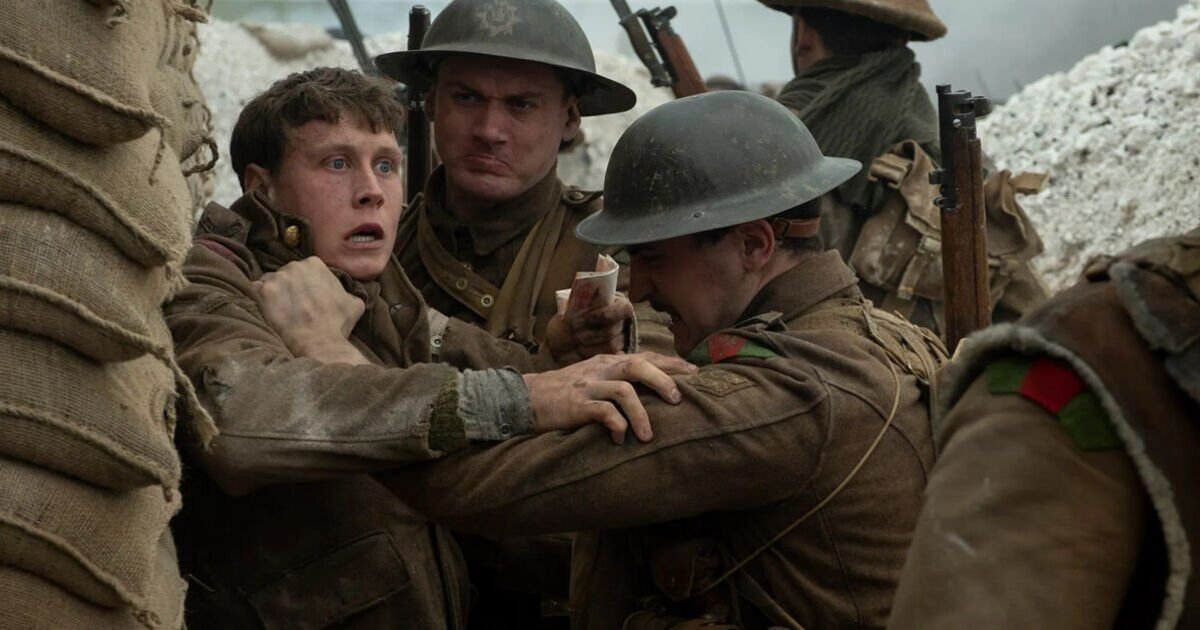
The British war film takes place after the German retreat to the Hindenburg Line during Operation Alberich, and follows two British soldiers in their mission to deliver an important message to call off a doomed offensive attack.
During World War I, Lance Corporal Schofield (played by George MacKay) and Lance Corporal Blake (Dean Charles Chapman) receive seemingly impossible orders. In a race against time, they must cross over into enemy territory to deliver a message that could potentially save 1,600 of their comrades including Blake’s own brother.
History: Operation Alberich was the code name of a German military operation in France during the First World War. The operation saw a major retreat from positions they had occupied into a new defensive line, known as the Hindenburg Line. It took place from February 9 to March 20, 1917. The Germans dug deep, wide trenches to stop tanks as well as dense belts of barbed wire.
After six months of planning and digging, the German army was ready to withdraw to a new, fortified and condensed line of defence, and fell back to their new positions along the Hindenburg Line. They moved 40 km of their existing front line, while laying waste to a huge area of French countryside and destroying anything the enemy might find useful. It is considered one of the shrewdest defensive operations of World War One.
Rating: The war film directed by Sam Mendes received a score of 88% on Rotten Tomatoes.
(Image: Universal)
3. A Bridge Too Far (1977)

The British-American war film depicts Operation Market Garden, a failed Allied operation in the Nazi-occupied Netherlands during World War Two. The Allies attempt to capture several strategically important bridges in the Netherlands in the hope of breaking the German lines. The film features an ensemble cast featuring Dirk Bogarde, James Caan, Michael Caine, Sean Connery, Edward Fox, Elliott Gould, Gene Hackman, Anthony Hopkins and Robert Redford.
History: On September 17, 1944, Allied forces launched one of the largest daylight air drops of World War II, Operation Market Garden. Parachuting in behind enemy lines, the goal was to secure key bridges behind German lines in the Netherlands for a British armoured column to break into Germany east of the Rhine River; however, the effort ultimately failed and led to more than 3,000 American casualties.
Ratings: The epic war film was directed by Richard Attenborough and received an impressive score of 96% on Rotten Tomatoes.
(Image: Getty)