
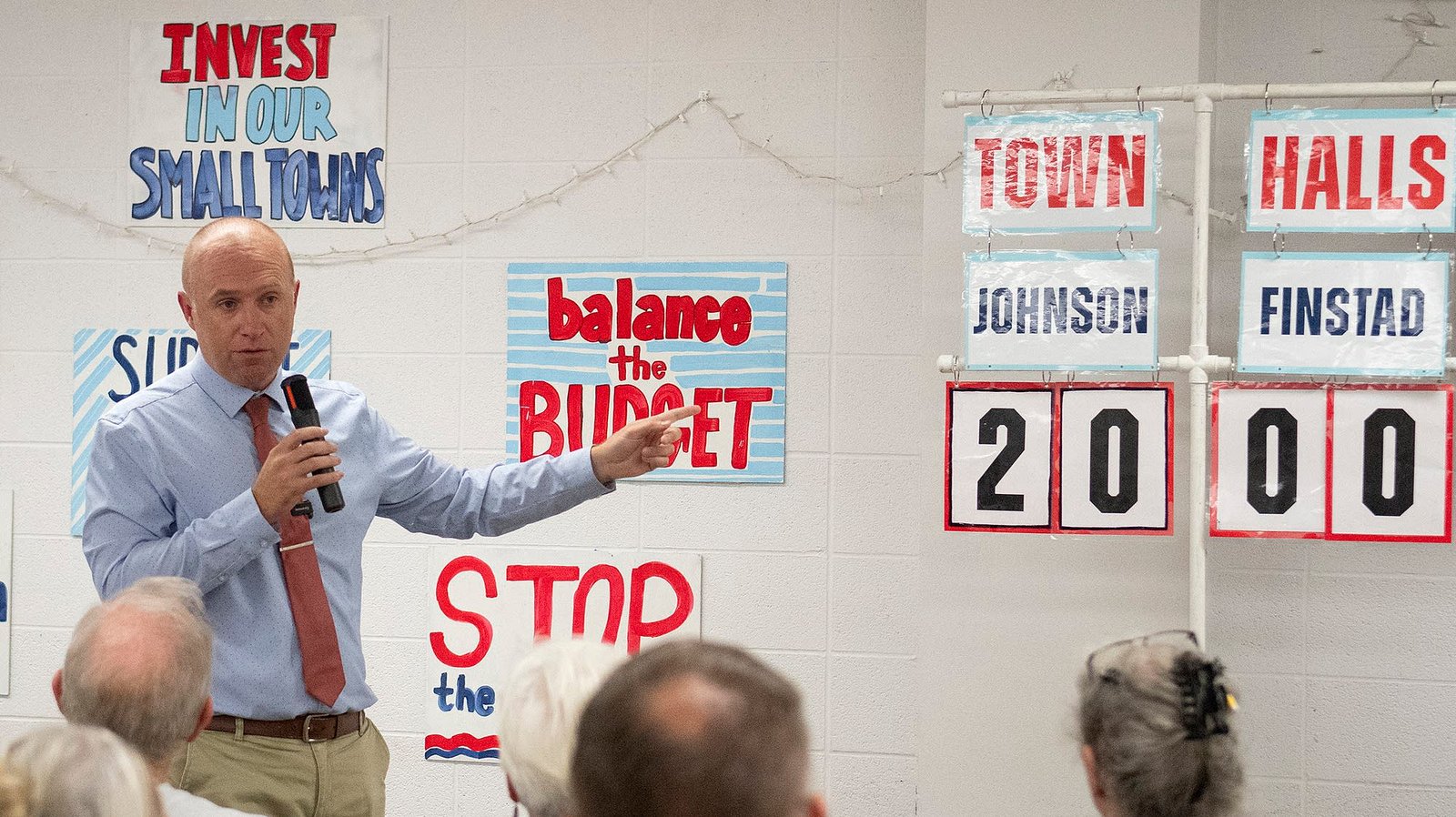

In a crowded room in the basement of the Martin County Public Library, DFL congressional candidate Jake Johnson introduced himself just as he had 19 times before during his 21-county tour of Minnesota's southernmost congressional district.
“I grew up with a father who was a garbage man, a mom who was a meter reader, and ten siblings,” he said. “Even with our hard work, I was a SNAP kid. We were a Medicaid family, and I wouldn't have gone to college if it wasn't for subsidized Stafford loans and Pell grants."
Johnson said the programs Republicans seek to gut got him where he is today: A Rochester high school math teacher attempting to unseat two-term Rep. Brad Finstad in the 1st Congressional District that has been in the GOP column since 2018.
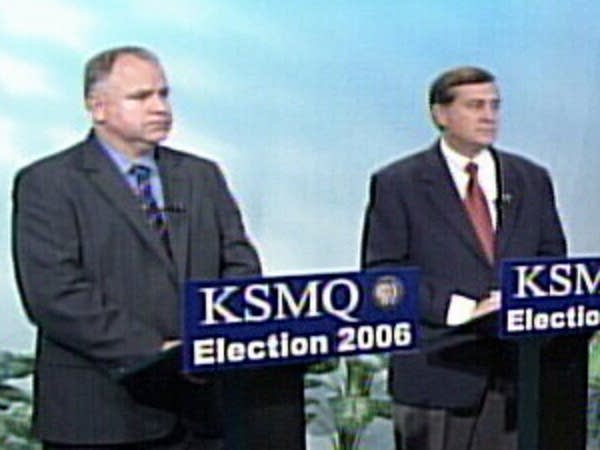
In some ways, the political mood today echoes 2006, the last time a Democrat snagged this district from the GOP. A Republican president had low approval ratings. The U.S. was at war in the Middle East. And the then Democratic candidate — now Gov. Tim Walz — was a teacher and political fresh face just like Johnson.
This year, Democrats hope for a parallel result. But Finstad isn’t taking this race for granted, noting he’s been all over the district as well.
“I have been engaging for four years, very productively,” Finstad stressed in an interview with MPR News.
Part of Johnson’s strategy are these town halls. They’re a bit of a dig at Finstad, who Johnson accuses of only talking to like-minded audiences.
“There was a lot of frustration with the fact that Congressman Finstad doesn't host any public meetings,” Johnson said. “We see a different method of leadership, and it's more responsive when you show up in a public place. Everyone is welcome."
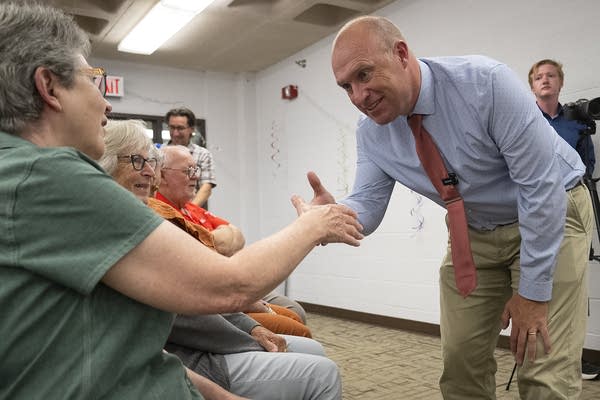
Listening to voters
Even though Johnson's events are advertised as open to anyone of any party, the crowd in Fairmont comes off as politically friendly. Questions posed to Johnson are about preserving mail-in balloting, his support for mental health program funding and whether kids should use technology in the classroom.
But Johnson said that some of these most frequent questions he gets at these town halls come from farmers.
“Our farmers are concerned about three things primarily that I hear the most. One, input costs are too high; tariffs are bad for input costs right now. The Iran War, also bad for input costs,” he said. “We're now in a trade war with Minnesota's largest trade partner, Canada, and nobody knows why.”
Johnson said Finstad stood by as President Donald Trump imposed tariffs on trade partners and started a war in Iran, both driving up costs for farmers.
Finstad, who won his seat four years ago, said that narrative is wrong.
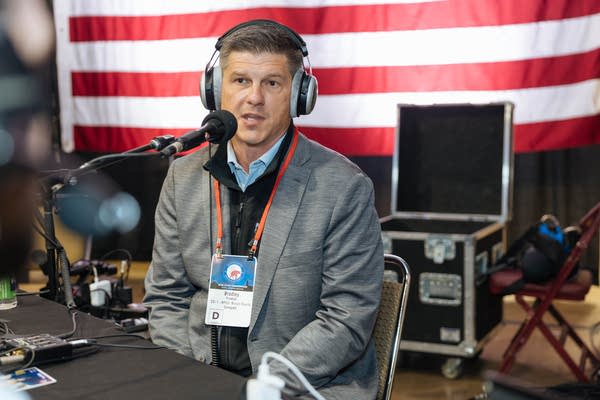
“I find it laughable. Find my social media and watch what I've done for the last four years. I am constantly engaging with constituents,” he said.
Of the idea he’s too loyal to Trump, Finstad pushes back.
“I would just say when I agree with the president, I'm not afraid to say that,” he said. “When I disagree, I'm also not afraid to say that.”
Finstad got to Congress after first serving in the Minnesota Legislature and later as head of the state’s turkey growers association and another top rural policy role. A farmer himself, Finstad said some elements in a proposed farm bill were inspired by what he's heard from the district’s producers, such as programs to support young people getting into agriculture. He said that when he’s talking to farmers, he hears optimism.
He points to rising exports for corn, dairy, ethanol and soybeans that he attributes to new trade deals reached under Trump.
“That comes after a very stale trade atmosphere for agriculture,” he said.
Finstad said he’s advocated for farmers in other ways — even when he’s out-of-step with the White House. He points to Trump administration policies that could weaken demand for biofuels.
“I've pushed back on the EPA, the president and the White House to say, ‘Listen, this is really important for us to keep growing and strengthening our domestic energy industry,’” he said.
2006 vs. 2026
Even though Finstad has notched prior wins by double-digit margins – his last victory was by 17 percentage points — Johnson is giving him a run for his money. Literally. Both candidates have raised $2 million as of the most recent fundraising reports. National Democrats are propping up Johnson. Groups on both ends are airing TV ads.
Demographics could play a role, too. The district’s most populous cities — Rochester and Mankato — are growing and becoming bluer in the process.
The attention Johnson has drawn from national groups and donors may also reflect similarities between his campaign and Walz’s 2006 upset against GOP Rep. Gil Gutknecht, said Minnesota State University Mankato political science professor Kevin Parsneau.
“Jake Johnson kind of fits the profile of the last Democrat who won the district. He's a teacher, just like Walz was. He's running as an outsider, a newcomer to politics. He's got a lot of union support,” Parsneau said
Finstad has clashed with Parsneau previously, seeking the professor’s termination or resignation after highlighting social media comments the congressman deemed inflammatory.
Whether Johnson's message can break through to Republicans is another question. Some political experts say voter enthusiasm will be critical, too. Republican voters discouraged by current affairs might not back Democrats, but they might not vote either.
An unlikely supporter
Gerald Woodley isn’t planning to stay home on Election Day. Woodley is going to vote for Johnson.
It’s an about-face for Woodley, who was a top Finstad campaign adviser when he served in the Minnesota House. Woodley has a long track record of working for the state Republican Party and candidates up and down the ticket.
But he’s become frustrated with Finstad’s track record in Congress.
“Brad Finstad was simply voting to support Trump as opposed to supporting the people of his district,” he said. “Farmers are really struggling right now. The high input costs of fertilizer and so on, and the low commodity prices because of the tariffs and the loss of foreign markets.”
So out of the blue, Woodley messaged Johnson on Facebook.
“I met him in New Ulm, and we spent about oh half an hour, 45 minutes, just kind of talking. I was impressed with his ideas,” he said. “You know the idea that he drove from Rochester to New Ulm to meet with me at Lola's restaurant was a big deal."
The question going into the fall is if there are enough people like Woodley out there to flip the district to the Democrats.


