
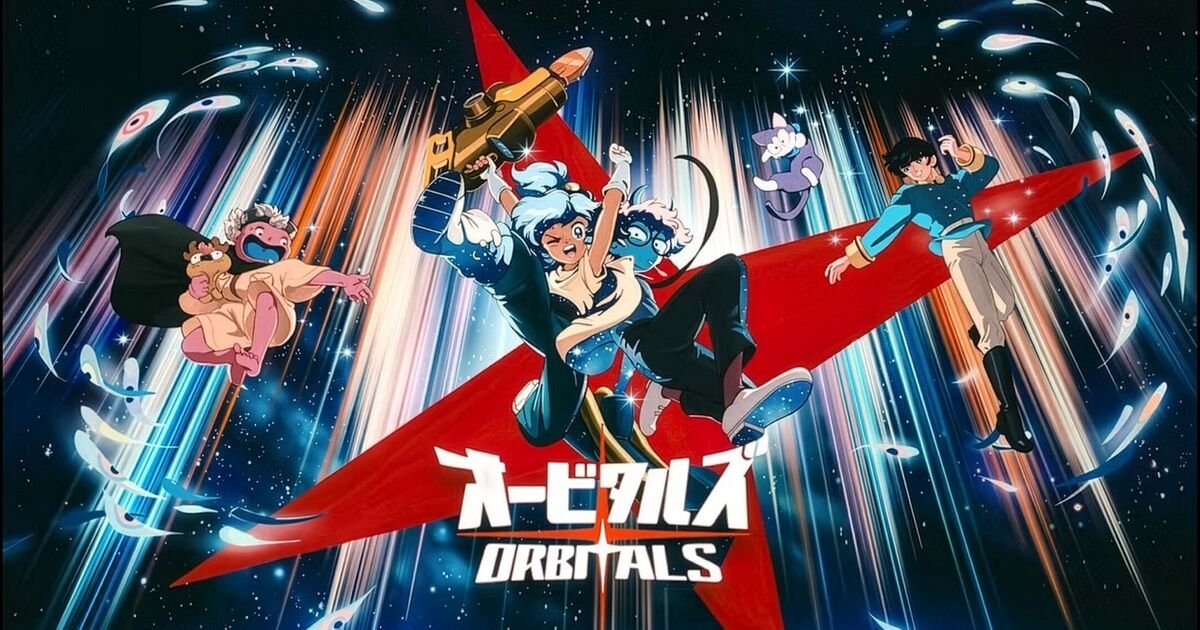

Orbitals. (Image: Shapefarm)
I’ve always felt when playing co-op games like It Takes Two and Split Fiction that they’d be perfectly suited for a Nintendo platform. There’s just something about the way the forced co-operative play that feels right at home with Nintendo’s family-centric ethos.
That’s why I was delighted to see Orbitals crop up in the last several Nintendo Direct’s, a co-op adventure following two budding space cadets, wrapped up in a stunning 90’s anime aesthetic. After completing the roughly eight hour campaign with my partner, I’m pleased to see that while Orbitals doesn’t do much to elevate the co-op game formula, it does at least match its contemporaries in both its platforming puzzles and style.
Right from the off, Orbitals absolutely oozes character. Before you even get into the game, the character selection screen beams its bright colour palette at you, the controllers graphically stylised in a gorgeous anime aesthetic that matches the rest of the game’s world.
You’re then treated to one of the game’s many fantastic cutscenes, which sets up the story of our two protagonists. You can tell that each of these cutscenes have been painstakingly animated by hand, every corner of the frame dripping with style.
Both me and my partner agreed that we could easily be watching a 90s anime episode straight from Crunchyroll. It’s so refreshing to see, and proof that an intentional, stylised art style will always be far more appealing to look at than the hyper-realism AI slop that Nvidia is pushing with its DLSS 5 tech.
Before long, you’re thrown into gameplay. One player takes control of Maki and the other Omura. They’re residents of a space colony that’s remained stranded on the edge of the galaxy for several years after their ship became damaged.
Maki is the hyperactive, chipper one of the group, constantly barrelling forwards at every opportunity. On the contrary, Omura is the more reserved, calculating one who’s much more observant as to what’s actually going on around them.
The pair bounce off each other well, which provides some entertaining mid-mission banter between the two. I also appreciated that developer Shapefarm didn’t try to drive a wedge between them at any point, nor lean into any sort of romantic interest. Seeing both a male and female protagonist exist in a game as platonic friends is rare in video games these days, and we appreciated that Shapefarm explored the characters in other ways throughout its story.

Orbitals. (Image: Shapefarm)
In terms of gameplay, each mission is separated into different areas of outer space with the pair navigating between them using their own ship. One player must take the pilot seat while the other man’s the guns.
What’s great about Orbitals is that it doesn’t lock you into roles and abilities based on your character like It Takes Two and Split Fiction does. You can choose between yourselves whether you want to fly or shoot, and the same extends to the several utility items which form the crux of most puzzles.
Most importantly, neither player ever feels left out. There’s always something for someone to do when flying about in the ship, whether that be dodging incoming attacks as the pilot or blasting away incoming rockets as the gunner.
There are even some dedicated combat sections which felt akin to piloting the Batmobile in Arkham Knight, only you’re only in control of one half of the ship. These sections required plenty of communication with me and my partner working out ways to prioritise targets and routes through the playspace to take everything down.
When you’re not in the ship, you’re exploring one of the several environments Orbitals has to offer. These vary greatly, with each area never outstaying its welcome.

Orbitals. (Image: Shapefarm)
One of my early favourites was a mining area built around timing puzzles, which again required plenty of great communication between me and my partner to get through to the end. There’s a mixture of well-timed button presses required here, as well as some expertly manoeuvred 3D platforming.
Most puzzles we were able to figure out almost immediately upon seeing them, with most of the challenge coming down to execution rather than logical thinking.
Some puzzles require the use of utility abilities which are picked up and stored on your ship. For example, one player might need to use a grappling hook to pull open a door while the other uses a water cannon to rotate a gear.
Again, I appreciated that we could decide which item to pick up on the ship before proceeding, meaning we both got to give everything a try at some point during the campaign.
The story of Orbitals is a little predictable – we both picked out who the main villain of the piece would be within the first 20 minutes or so, and were proven correct by the third act. That being said, it remains an entertaining romp regardless, with a rather emotional ending that we actually didn’t see coming.
Shapefarm also leaves the door open for a sequel, the concept of which would be very exciting. The studio might not have moved the needle when it comes to co-op gameplay, but I had just as much fun solving puzzles as a duo here as I have in other co-op games of this ilk.

Orbitals. (Image: Shape Farm)
The Verdict
Through a stunning art style, masterful animation and thoughtful puzzle design, Orbitals proves itself as one of the many reasons it’s worth owning a Nintendo Switch 2 in 2026.
It’s an excellent way to spend eight-hours with a co-op partner, and is a beacon for what developers should be aiming for when it comes to both art direction and polish. I can’t wait to see what Shapefarm does next.
4/5
Reviewed on Nintendo Switch 2. Code provided by PR.


