

The Blood of Dawnwalker. (Image: Rebel Wolves)
Upon booting up The Blood of Dawnwalker for the first time, it’s not afraid to wear its influences on its sleeve. It’s understandable that sharing talented developers with the team that brought us The Witcher 3 would make their fingerprints easy to recognise.
Some similarities are obvious. The health, stamina and experience bars are pulled almost one for one, as is the dialogue menu that uses white text for superfluous speech and yellow to identify what will advance the quest.
There’s also the focus detective mode, which is pretty much a 1:1 recreation of Witcher Senses. Even the way Coen – the titular Dawnwalker and protagonist for this dark fantasy adventure – speaks is Geralt-coded, muttering to himself in shortened sentences at a similar cadence to our favourite monster slayer.
Such brazen similarities had me worried that The Blood of Dawnwalker wouldn’t manage to carve out its own identity, forever damning itself to comparisons with what’s widely regarded as one of the best RPGs of our generation, if not all time.
Thankfully, the team at Rebel Wolves has delivered a refreshing new take on what it means to play an RPG with Blood of Dawnwalker. Its narrative sandbox lands extremely well, almost necessitating multiple playthroughs to fully get the most out of its world, characters, and story.
It’s an unfortunate shame, then, that the vast majority of its gameplay is held up by a dull and tedious combat system that left me actively avoiding foes by the halfway point, and quickly finding frustration that while its narrative may be driven by player agency, its gameplay is far more rigid in its execution.
A race against time
While Witcher fans are used to slaying monsters, in The Blood of Dawnwalker, you embody one. Coen of Laslea serves as this game’s protagonist, a human recently turned vampire.
The game’s three-hour prologue follows Coen through his transition as he takes part in a revolt against the vampire coven that holds rule over his valley. Thanks to working in the silver mines as a boy, Coen’s transformation goes wrong, and he ends up becoming a Dawnwalker – a vampire variant that can survive in the daylight.
Before long, Coen is set free in the open world with one major quest – rescue his family from Brencis, the big bad vampire in charge.
While most RPGs would set you a long string of main questlines to complete in the run-up to the final conclusion, Rebel Wolves adopts a narrative sandbox approach here. There’s no ‘main quest’, per se. Instead, you’ll need to explore the world and find quests for yourself, which will ultimately lead you to allies, artefacts, weapons and upgrades you can use to take down Brencis.
The catch? You’ve only got 30 days to save your family before Brencis kills them all. Taking part in quests big and small as well as levelling up your character takes a chunk out of the day, meaning there’s physically not enough time in the month to complete everything there is to see and do in the world of Dawnwalker.

The Blood of Dawnwalker. (Image: Rebel Wolves)
Right from the start, this showcases itself as an exciting premise. After investigating a rebel group known as the Manumits, I encounter a member who can be freed from the prison cells of a nearby encampment. Doing so will take up three slots of the day – three slots I could have spent dismantling other parts of Brencis’s regime.
Moral choices like this rear their head throughout The Blood of Dawnwalker, forcing you to choose whether to get to know characters more deeply or better serve your own personal mission.
The mechanic also punishes inaction as well as your action. In the game’s prologue, you can choose whether to investigate a tapestry that’s gone missing from the village. I chose to find the culprit, return the tapestry and keep the perpetrator’s identity hidden for everyone’s safety.
However, I know that in another playthrough, I could have chosen to completely ignore that quest altogether, and the poor woman in charge of making the tapestry would have borne the brunt of the vampire’s punishment.
It’s a novel twist on the RPG structure that gives agency to what you choose not to engage with as well as what you do. Just like in real life, time ticks on regardless, and it’s so interesting to see how the story changes and reacts to choices outside of direct dialogue options.
Making your mark
As there’s no ‘main quest’ per se, your adventure through The Blood of Dawnwalker really does feel like your own. There are a few quests that feel substantial and are tied to certain characters or factions, each of which felt like they could have been main quests despite not being labelled as such.
You’ll encounter a romantic interest reckoning with her past as a witch, and a rebel group grappling with the sacrifices they’re willing to make for freedom, and which ones they’re not.
I found the writing here to be pretty great across the board, regularly exhausting most of the dialogue options I was presented with to learn more about these characters and how they feel about the world they live in.

The Blood of Dawnwalker. (Image: Rebel Wolves)
Some of these quests are gated by time or by reputation, encouraging you to wreak havoc around the world by dismantling some of Brencis’s operations. These activities could be freeing prisoners, destroying blood transport convoys or tearing down Vrakhir banners, all of which also takes chunks of time out of your days as well as chips away at the Court, an interconnected web that’s very reminiscent of Assassin’s Creed Odyssey’s Cultist system.
Sadly, these activities start to get repetitive quickly. Most of these quests must be completed by eliminating all the enemies in the area with no option for stealth or talking your way out of them. With each activity always falling back on the combat, they quickly start to feel like mandatory busywork before you can get to the meat and potatoes of the more interesting quests.
Clashed swords
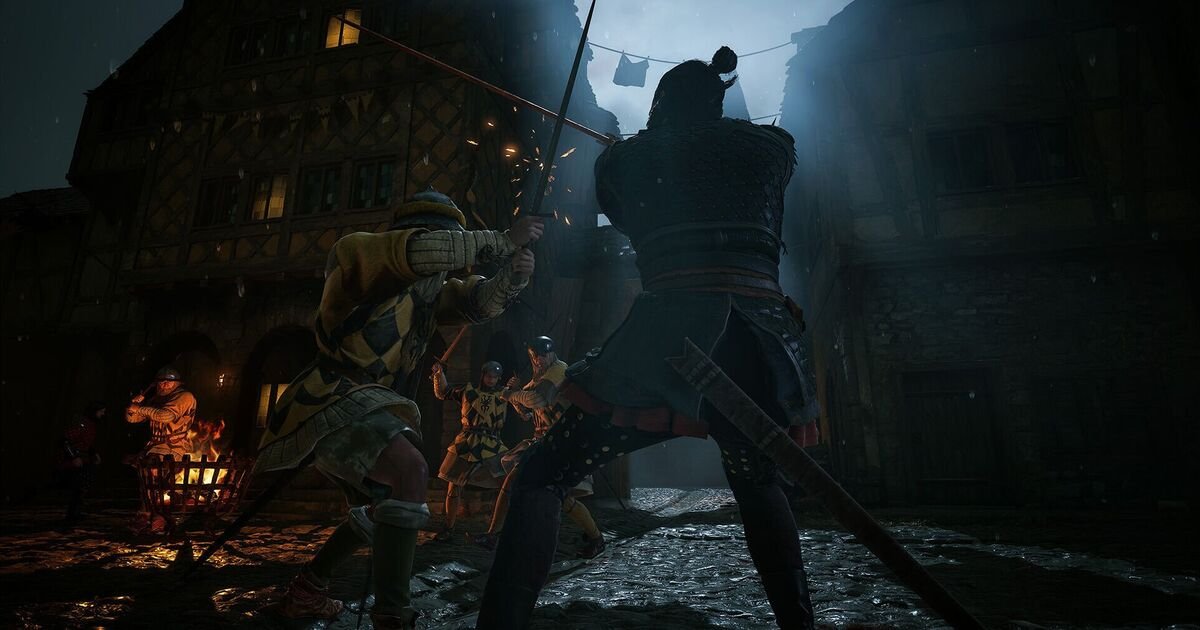
At the start of Dawnwalker’s runtime, the combat feels promising. In Kingdom Come Deliverance style, each enemy appears with a UI element indicating which direction their incoming attack is coming from. You then have to push the left stick in the direction of the attack while blocking at the right time to parry it, earning yourself back a bit of stamina in the process.
For the first few hours, this system is engaging. I quickly found the combat to be akin to a rhythm action game, reliably hitting parries without much thought and felling foes with ease on the middle-of-the-road ‘fair’ difficulty.
Sadly, while this combat feels engaging at the start, I don’t think it holds up for a 40-hour adventure, and that’s mostly down to one reason – there just isn’t any variation in how enemies attack you.
Sure, you’ll face off against Brencis’s soldiers, forest spirits, bears, wolves, zombified humans – the lot. The Blood of Dawnwalker actually has a pretty great range of enemies standing in your path throughout its runtime.

The Blood of Dawnwalker. (Image: Rebel Wolves)
However, outside of a few bosses, the way in which these enemies attack you is basically no different. They’re essentially interchangeable with no discernable strengths, weaknesses, or differences in attack pattern, with Coen reliably hitting directional parry combo after directional parry combo.
The mundanity isn’t helped by the fact that enemies scale with Coen’s level. Whether you’re tackling a guard at Level 1 or Level 40, they’re still going to take 20 or more hits to take down. I played around with all of Dawnwalker’s difficulty settings here and just couldn’t find a combination that felt satisfying.
Coen can unlock active abilities on his journey that vary the combat slightly, taking bigger chunks of damage out of enemies at once and providing new ways to deliver crowd control. However, they weren’t enough to alleviate the feeling of staleness that the combat left me with after several long sessions, and I began to find myself looking for other ways to complete quests that didn’t involve fighting.
Freeing narrative, rigid quest structure
This is also where I found The Blood of Dawnwalker to be a little disappointing. While the narrative may be a sandbox, that same flexibility doesn’t extend to its gameplay, and there were several quests where I found myself wishing for more open-ended ways to approach them.
For example, one series of activities has Coen destroy caches of blood reserves. Rather than approach the encampment head on, I managed to slink through the back, past the guards, and into the cellar.
Upon dispatching the guards downstairs, I went to destroy the barrels, only to find that option wouldn’t appear until I disposed of the guards outside in the courtyard too, despite them being unaware of my presence.
I was then presented with a choice as to whether I destroy the blood reserves or collect it for my own use as a vampire, so there is some character and narrative influence there, but the way in which you go about the quests remains rigid in a way that feels at odds with the rest of the game’s sandbox nature.
That’s especially true when you consider that there’s a crouch button and Coen’s short-range teleport and wall-walking abilities in vampire form. I found myself wondering if stealth was once considered at some point in development, only to be canned at a later stage.

The Blood of Dawnwalker. (Image: Rebel Wolves)
It also feels like there’s a bit of an imbalance between Coen’s daytime and nighttime abilities with fights appearing much easier in vampire form thanks to an abundance of life-steal abilities.
It was actually thanks to this and a clumsy misstep with the short-range teleport ability – which constantly felt awkward to use – that I ended up killing one of Brencis’s lieutenants early into my playthrough.
Due to their incoming attacks being incredibly easy to parry with generous timing windows and very early telegraphed attack patterns, I was able to defeat them without completing any of the prerequisite preparation on the Court board.
To be able to bypass all of that is a cool concept, but only if it’s something you’re looking to achieve. It feels like it should have been more difficult, and although I could have saved-scummed my way back, that didn’t feel in the spirit of how Rebel Wolves intended for this game to be played. You’re supposed to live with the consequences of your actions, even if those consequences feel unearned.

The Blood of Dawnwalker. (Image: Rebel Wolves)
The fact that Rebel Wolves has managed to deliver a massive open world RPG with a narrative that fits together no matter which order you play it in is impressive. In my experience, it ran exceptionally well on PC while looking pretty incredible on medium settings.
Although I’ve definitely played buggier games, I did find The Blood of Dawnwalker to be a little rough around the edges in places.
As I plunged my sword into the belly of one B-plot villain, the sound effects were completely missing, ripping most of the satisfaction from the scene. Another scenario saw the voices of three soldiers continue to play out long after they’d been felled, causing me to do laps of the area looking for any remaining stragglers before realising they were speaking from beyond the grave
Elsewhere, innocent villager NPCs spawned right in front of me during combat, causing Coen to accidentally mow them down.
They’re minor in the grand scheme of things, but it takes away the feeling that you’re playing a polished product. Rebel Wolves is likely to drop a day one patch that tidies some of these things up, but I have to review what I have in front of me, and quirks like these cropped up regularly throughout my playthrough.
The Verdict
The best bits of The Blood of Dawnwalker are fantastic and genuinely move the genre forward in a meaningful way. When I inevitably boot up The Witcher 3 Remastered later this month, it’s going to feel very weird abandoning a side quest as its characters remain frozen in time while I prattle about playing Gwent for weeks at a time.
I regularly looked forward to seeing what new characters and themes the next quest had in store for me while exploring the Vale Sangora. I’m already excited to chat with friends about which order they tackled their quests in, and how their inaction affected their story as much as their direct choices.
It’s such a shame that what feels like 75% of its gameplay relies on a combat system that feels mundane to engage with after a certain number of hours. Having variation in how enemies attack would have gone a long way here, as well as adding more agency in how players can complete their quests rather than forcing the lethal option at every step.
I’d be very excited to see a second stab at this series – one that’s just as ambitious gameplay-wise as it is narratively.
3/5
Reviewed on PC. Code provided by PR.


