
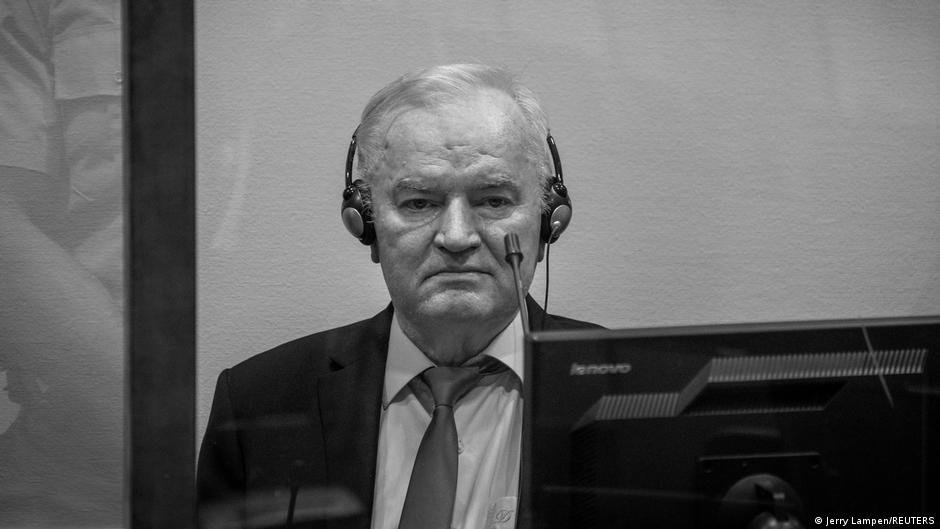
More than 30 years after the end of the war in Bosnia and Herzegovina (1992-1995), Srebrenica remains emblematic of its brutality. And no one is more closely linked to the genocide that took place in the small town in eastern Bosnia than Ratko Mladic, the former commander-in-chief of the Bosnian Serb army.
Although the United Nations had declared Srebrenica a “safe area,” Bosnian Serb forces attacked the town. Within just a few days in July 1995, they expelled women and children, then killed more than 8,300 unarmed Muslim boys and men in the nearby village of Potocari — on Mladic’s direct orders, according to the verdict handed down by the International Criminal Tribunal for the former Yugoslavia (ICTY) in The Hague 22 years later.
At the time, Srebrenica was the largest massacre in Europe since World War II. The ICTY classified it as genocide. Mladic was also held responsible for other war crimes beyond the Srebrenica genocide. Under his command, the years-long siege of Sarajevo began at the start of the war. The city was shelled for more than 40 months, killing around 11,000 people, including more than 1,600 children.
Mladic always claimed that he targeted only military objectives. But numerous reports and intercepted radio communications indicate that civilian facilities and residential areas were also deliberately attacked. Around 100,000 people were killed during the four-year war in Bosnia, while some 2.2 million were driven from their homes in cities and villages across the country, half of its total population at the time.
‘The butcher of the Balkans’
In 2017, Mladic was sentenced to life in prison by the tribunal in The Hague.
International media dubbed him “the Butcher of the Balkans.”
He was found responsible for some of the most serious war crimes and the genocide committed during the Bosnian War.
Mladic consistently denied any responsibility. He saw himself as an avenger of the Serbs for centuries of Ottoman rule in the Balkans, and viewed Bosnia’s Muslims, who today call themselves Bosniaks, as direct descendants of the Turks. In front of his soldiers, he referred to them simply as “the Turks” and showed no empathy.
“Borders are always drawn with blood, and states are marked with graves,” he is quoted as saying.
Career in the Yugoslav army
At the beginning of the Croatian War in June 1991, when Serbs living in Croatia rose up against the independence of the former Yugoslav republic with active support from Serbia, Mladic’s role fundamentall changed. As a colonel in the Yugoslav army, he became commander of the 9th Corps in the Croatian city of Knin. His task was to organize Serb militias and support them in their fight against Croatian independence.
Under Mladic’s command, the Croatian cities of Sibenik and Zadar were bombarded, and Croatian civilians were driven from surrounding towns and villages. In May 1992, he took on the same role in Bosnia. By then promoted to general, Mladic became commander-in-chief of the Bosnian Serb forces, seeking to establish a territorial link between Serb-held areas in the east and west of the former Yugoslav republic.
Flight, arrest and final verdict
At the height of his career, Colonel General Ratko Mladic was a fervent Serbian nationalist. But he began his career as a committed communist. Born in eastern Bosnia in 1943, Mladic was just two years old when his father, one of Tito’s Partisans, was killed by fascist Croatian Ustasha militia. The loss is often described as a formative influence, shaping his later worldview.
As a young man, Mladic embarked on a military career, attending the Military Academy in Belgrade. He later graduated at the top of his class. He quickly rose through the ranks of the Yugoslav army, which for many years was regarded as one of the most stable institutions in the multiethnic state.
Serbian nationalist
Before the end of the Bosnian War in late 1995, Mladic was indicted by the International Criminal Tribunal for the former Yugoslavia. But he evaded arrest for years. Supported by networks within the Serbian military and political establishment, he lived largely undisturbed underground and was even seen in public. He was finally arrested in 2011, after 16 years on the run and mounting international pressure.
The subsequent trial in The Hague lasted a total of 523 days. Nearly 600 witnesses testified, while numerous documents and other pieces of evidence were examined. Mladic was ultimately sentenced to life in prison at trial, among other charges for genocide, crimes against humanity and war crimes. In 2021, an appeals chamber upheld the verdict, making it final. Legally, this established his responsibility as one of the principal figures behind the crimes committed during the Bosnian War.
A war criminal who saw himself as a hero
Internationally, the verdict was hailed as historic. United Nations officials saw it as a signal that accountability can still be pursued decades after crimes are committed. For many survivors and relatives of the victims, the verdict was a long-overdue but important acknowledgment of their suffering.
Mladic himself, however, remained defiant to the end. Throughout the trial, he maintained that he was innocent, calling the charges against him “disgusting” and the tribunal “satanic.”
Many of his supporters in Serbia and among Bosnian Serbs still see him as a hero. While he is regarded internationally as a war criminal, his admirers continue to portray him as a defender of Serbian interests and a hero — even painting his likeness on walls.
While he was still on the run, Mladic threatened his pursuers, claiming he always carried a poison pill and that he would never be captured alive. But he never swallowed the pill during his decades in hiding. He survived several strokes while in prison.
Ratko Mladic died on August 27, 2026, at the prison hospital in The Hague at the age of 84.
This article was translated from German.


