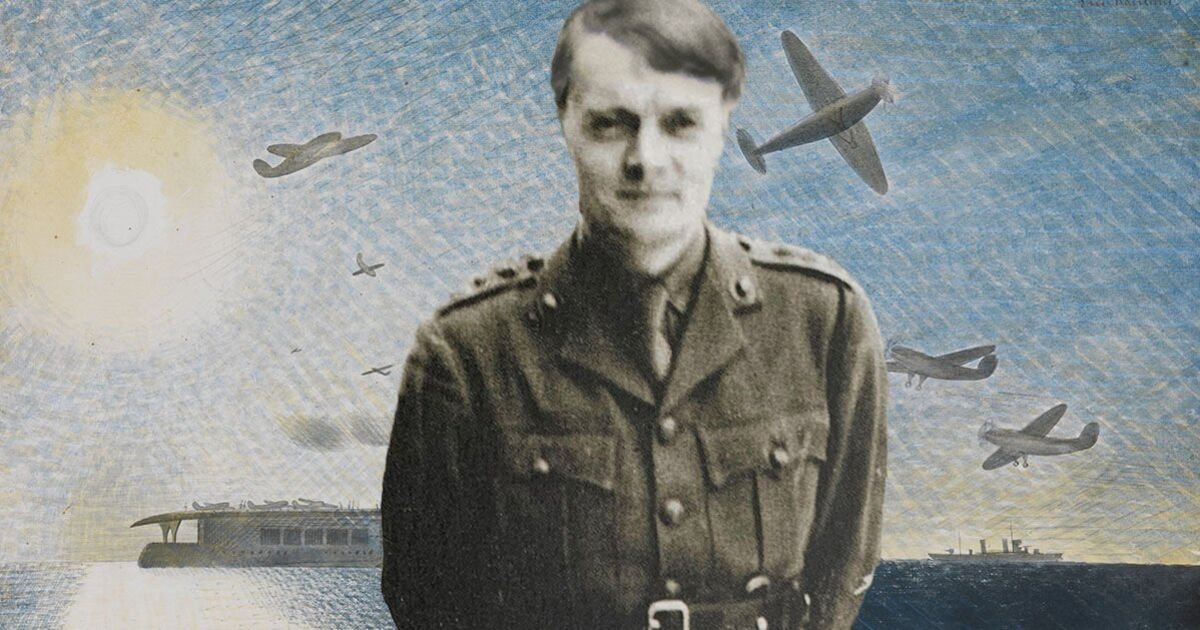

Eric Ravilious with detail from his painting HMS Glorious in the Arctic (Image: Imperial War Museums)
Life as a war artist has never been a soft option – even if at first glance it might appear so. Of the 37 official British war artists called to duty in the Second World War, three were killed, a loss rate representing 8% of their total number – in other words exactly double the death rate suffered as a whole across all three of the armed services.
One of those war artists who paid the ultimate price, and the first of their number to die, was Eric William Ravilious. As an artist, Ravilious never particularly sought fame. In many respects, he and his wife, the artist Tirzah Garwood, eked out what was very much a hand-to-mouth existence in the immediate pre-war years.
However, both had begun to attract serious attention in the artistic sphere. Ultimately – and fatefully – Ravilious would also attract the attention of the War Artists Advisory Committee (WAAC). Before the war, and working from their home in East Sussex (and later Essex), Ravilious did garner some useful and relatively profitable commissions. These included the distinctive wood engraving artwork of two top-hatted Victorian cricketers which adorns the front cover of Wisden’s Cricketers’ Almanack to this very day.

Ravilious and his wife, the artist Tirzah Garwood (Image: Courtesy Melody Foreman)
Another significant commission was for Wedgwood, although those iconic designs didn’t see light of day until after the war and the death of their creator. Incredibly, and by the time of the appearance of those Wedgwood ceramics in the 1950s, Ravilious as an artist had been largely forgotten. It was almost as if the bright light of talent – a unique brilliance which flamed ever stronger in wartime – had been extinguished.
Ravilious’s disappearance was accompanied by the ‘vanishing’ of many original examples of his work. Indeed, it was only the curiosity of his three children in the 1970s which led to them wanting to know more about their father and where any surviving artwork might be. That quest ended, quite literally, under the bed of his friend and fellow artist, Edward Bawden. Here, roughly bundled up, was the physical embodiment of the Ravilious legacy in the form of many of his lost paintings.
Gradually but inexorably, Ravilious emerged back into public consciousness. The momentum of publicity of this ‘forgotten’ art gathered pace, reaching almost peak interest by the early part of this century. By then, galleries vied for exhibitions of his work while publishers sought rights and licences to publish examples of his paintings.
When the WAAC selected Ravilious as one of the first official war artists in early 1940, he was delighted. War, in all its dimensions and manifestations, excited Ravilious through its limitless artistic possibilities. Commissioned as an honorary captain in the Royal Marines, one of his first assignments was to Norway to record the ultimately doomed allied efforts to thwart the country’s Nazi invasion. Arguably, it was from here that Ravilious produced some of his finest work, including Midnight Sun.

Alfred ‘Ginge’ Culver who flew Ravilious’s ill-fated search plane (Image: Imperial War Museums)
Having returned to the UK after the end of the disastrous campaign, he became restless. Despite the danger, he yearned for more work overseas. Perhaps he had grown tired of the home-grown scenes of wartime Britain, painting what were artistically brilliant but relatively staid and risk-free scenes of training aircraft or, for example, his well-known depiction of a huge ship’s propeller on a railway wagon.
He wanted more. It would come with an assignment to Iceland. For Ravilious, this must have seemed like the dream posting. Not only would he likely see some action in dramatic arctic seas, but the bleakly rugged landscapes excited him – a thirst for such backdrops to his paintings was very likely triggered by exposure to Scandinavian landscapes during his Norwegian sojourn.
He was, however, dead before being able to execute what might well have been the crowning glory of his war artistry.
On September 1, 1942, not long after Ravilious’s arrival in Iceland, a Lockheed Hudson aircraft of RAF Coastal Command’s No 269 Squadron failed to return to its base at Kaldadarnes after an anti-submarine mission. Immediately, the squadron mounted an extensive air search for the overdue aircraft, its crew comprising Pilot Officer T R Prescott and three sergeants. Nothing was found. Survival time in those unforgiving waters was counted in minutes, but hopeful that the crew had made it into their dinghy, the search continued early the next day.
This time, Pilot Officer Alfred ‘Ginge’ Culver, 24, already decorated with a Distinguished Flying Medal for bravery in air combat, and his crew were detailed for the search along with two other Hudsons. Ravilious volunteered, probably enthusiastically, to go along as a passenger with Culver and his crew.

Runway Perspective, painted by Ravilious around 1942 (Image: Imperial War Museums via Getty)
After all, here was an opportunity to gather more material in his line of duty as a war artist. Not only that, but he contributed another pair of eyes to search the wild and cruel seas. What happened after Hudson FH385 departed into the pre-dawn darkness of September 1, 1942, remains unknown, but after it lifted off at 5.06am hours that morning neither the aircraft nor any of those on board were heard of again. The four-man crew and the war artist were declared missing on active service.
The other two Hudsons returned safely. In all probability, and although we will never know, Hudson FH385 likely became a victim of the weather. A clue that this may have been a factor in the loss of the four RAF airmen and their noted war artist passenger lies in an official contemporary report, stating: “The weather conditions prevented any search [for Hudson FH385] on 2 September 1942, but an extensive search was made on 3 September without result.”
Those tragic airmen who died with Ravilious and Culver were Plt Off Neville Graves-Smith, 29, Flt Sgt William Day, 23, and Flt Sgt George Barnes, 25. Now, a new book by Melody Foreman, Love as Strong as Death, paints a picture of those five men’s lives and adds another important layer to the narrative of the Ravilious story by providing a poignant denouement.
As is often the case with artists, Ravilious predeceased his eventual fame. The possibility the RAF aircrew who died with him knew little or nothing of his work, cannot be excluded. The addition of his name to Culver’s flying logbook, misspelled as ‘Captain Revelliers’, underscores that point.

Searchlight at Dusk, 1941 by Eric Ravilious (Image: Sepia Times/ Universal Images Group via Getty)

Love As Strong as Death by Melody Foreman is out now (Image: Fighting High Ltd)
In Love as Strong as Death, Foreman focusses on the stories of the lives of the four courageous RAF fliers who lost their lives along with Ravilious. Except in the families of those individual casualties, they were merely a tragic statistic – men who were not only lost on active service, but who were also ‘lost’ within the global figure of 5,866 RAF Coastal Command fatalities.
Of the 70,000 men and women of the RAF killed during the war, 20,000 have no known grave and into the latter category fell the fates of four RAF fliers – men whose deaths in 1942 would be intertwined with the loss of 39-year-old Ravilious.
Today Plt Off Culver and his crew are commemorated on the Royal Air Forces Memorial at Runnymede, whilst Captain Eric Ravilious is commemorated by name on the Chatham Naval Memorial. In writing these stories, Foreman has given them back their names. In the same way that the four fliers may not have heard of Eric Ravilious in 1942, so the wider public will not have heard of Alfred Culver, Neville Graves-Smith, William Day or George Barnes. Now they have.
Nobody would doubt that ‘Ginge’ Culver and his crew courageously gave their lives in the service of their country. But so had Eric Ravilious. To quote playwright Alan Bennett: “Painting was Eric’s active service, and he gave his life for it.” Long after the event, it’s fitting that his name can now be linked to the brave men who went to their deaths alongside him.
Love as Strong as Death: Ravilious, the Pilot, and the Missing Aircraft, by by Melody Foreman (Fighting High Ltd, £25) is out now