Two satellites designed to enhance the monitoring of extreme weather events linked to climate change have been successfully sent into orbit by the European Space Agency (ESA).
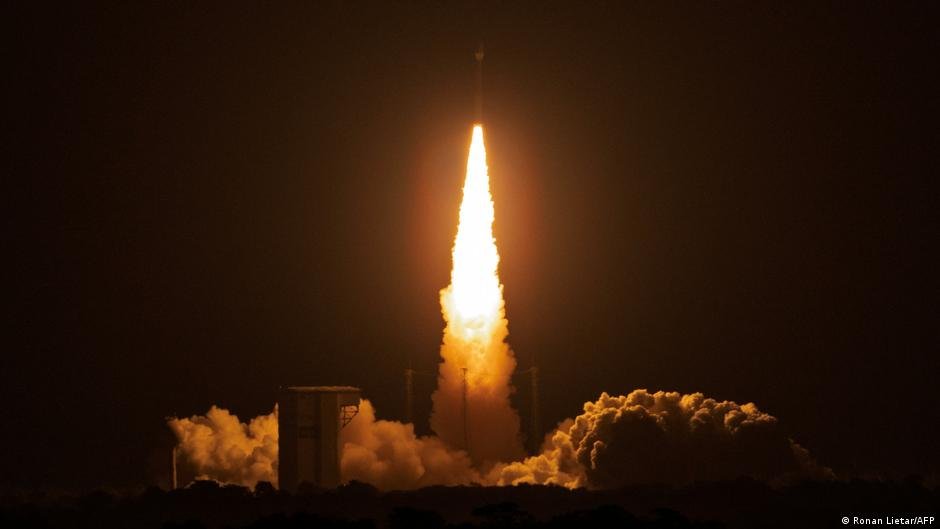
The Vega-C rocket carrying the Sentinel-3C and Flex satellites lifted off from the Kourou space center in French Guiana at 10:21 p.m. Monday (0121 GMT Tuesday), with the two spacecraft entering sun-synchronous orbit within two hours of lift-off.
What will the Flex satellite do?
The Flex (Fluorescence Explorer) satellite aims to provide data on the impact of heat waves on plant matter by monitoring the very faint fluorescence emitted by plants when they carry out photosynthesis.
That fluorescence gives an indication of how efficiently vegetation is converting sunlight and carbon dioxide into energy.
The measurements provided by the satellite will thus “help scientists assess plant health, ecosystem productivity and the effects of environmental stress and climate change,” according to ESA.
The €350 million ($403.5 million) mission is planned to last three years.
The satellite will orbit the Earth 14 times a day, revisiting particular locations every 27 days.
What is the role of the Sentinel-3C satellite?
The Sentinel-3C satellite is to collect data from the marine environment, including temperature, wave height and ocean currents.
It will also monitor land use and land cover with the aim of optimizing yields to prevent food crises.
Sentinel-3C is part of Copernicus, the Earth observation component of the EU’s space program.
Simonetta Cheli, the director of Earth Observation Programmes at the ESA, described the missions as “essential” in helping with the “climate change we are experiencing.”
Edited by Richard Connor
Tired of missing our real-time updates? Click here to add DW as a Preferred Source on Google.