
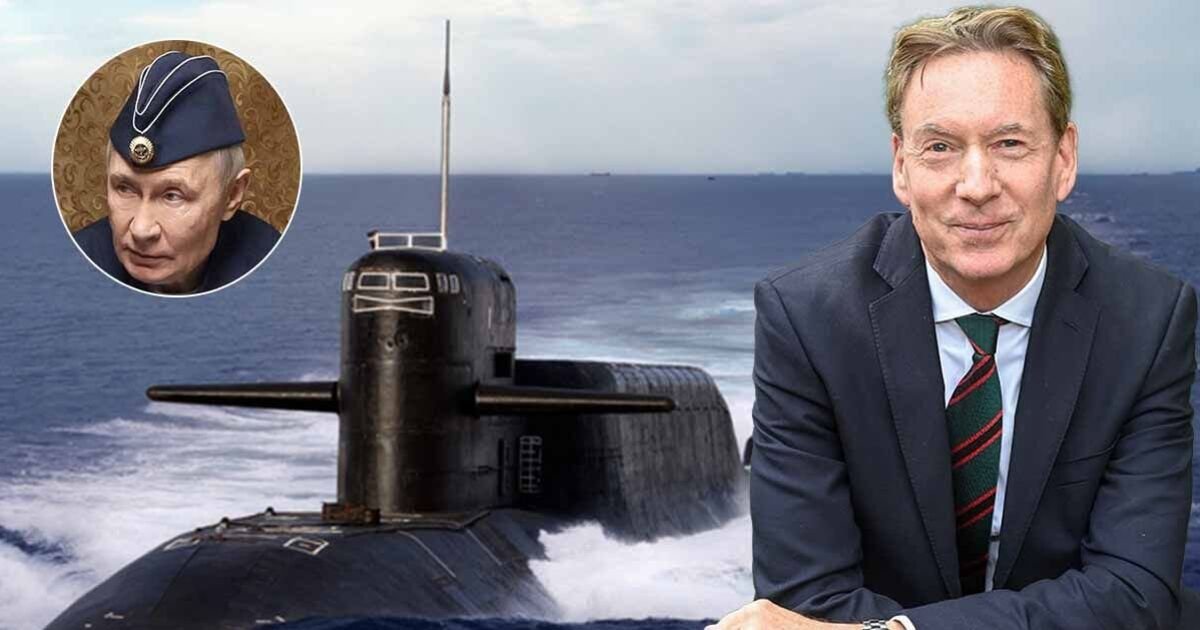

Purtin knows the UK has no middle rung on the escalatory ladder, says Frank Gardner, right (Image: Getty)
Veteran BBC Security Correspondent Frank Gardner has admitted to testing the Arabic of “impressive” new MI6 boss Blaise Metreweli – and says she passed with flying colours. “I’m sick of people saying, ‘Oh, so-and-so’s Arabic is really good, and it turns out they can count from one to ten and that’s it,” chuckles Gardner, who is himself fluent. “But she learned it through total immersion in the Middle East – the right way to do it.”
Metreweli became the first female head of the Secret Intelligence Service in October, following the retirement of her predecessor Sir Richard Moore. She had spent much of her career living and working abroad while the UK was fighting in Iraq and Afghanistan. She was previously head of Q branch, named after the fictional MI6 gadgets division in Ian Fleming’s James Bond books and at the forefront of equipping the nation’s spies.
“I think she’s quite impressive,” Gardner continues. “There have previously been female directors in the top tier, but she is the first woman to be ‘C’, as the bossis known. Her opening speech went down well. She said MI6 needs to get back toits Special Operations Executive roots and take the gloves off, but without sinking to the level of its adversaries.”

Impressive: new MI6 boss Blaise Metreweli (Image: Getty)
However, it’s a difficult balance, he admits, because the nation’s main rivals in an increasingly fragile world include The Federal Security Service of the Russian Federation – or FSB – and the GRU (Russian military intelligence). “They have few holdbacks or moral scruples,” he tells me.
“Imagine spraying Novichok nerve agent on a door handle, knowing another human being is going to grasp that and die a hideous death. Or getting somebody to drink polonium out of a teapot, knowing that their insides are going to basically melt and they’ll die an agonising death.”
Both such horrifying scenarios have taken place in the UK since 2006, yet Britain remains in what the veteran journalist and broadcaster describes as a “below-threshold war” with Russia – something for which we should probably be strangely grateful.
Below threshold, he explains, means under the boundary of open, declared war – the sort of clandestine threats that keep the government and security services working overtime without necessarily troubling the general population.
“The constant cyber-attacks, the scoping out of our subsea cables and interference in democratic elections in several countries in the West,” explains Gardner. “Probing of our airspace, the sabotage of warehouses belonging to Ukrainians in East London, incendiary devices in cargo shipments that blew up in Germany, arson attacks on a house linked to the former Prime Minister Keir Starmer – things like that.”

Gardner says the UK has no effective defences against Russia’s missiles (Image: Getty)
The chances of things turning hot – as happened in Ukraine in 2022 after eight years of propaganda, sabotage and general stirring by Russia – are low, he believes, precisely because the British Isles are so poorly defended against the threat of attack.
“We have no effective air defence against Russia’s missiles – we’re wide open. We have no Golden Dome, we’ve got no Iron Dome. We’ve got our Type 45 destroyers, which could intercept the first wave, but most of them are not actually operational and those would run out of counter-missiles very quickly.
“The second wave would have a complete freedom to choose targets, whether it’s London or nautical targets in Portsmouth or Faslane or wherever. And the problem for the UK – and Putin knows this – is that we have no middle rung on the escalatory ladder. We don’t have tactical nukes. We couldn’t retaliate without having to go full strategic nuclear, which is horrific. That’s the end of days, that’s mushroom clouds over Moscow and London.”
On the plus side, this means Vladimir Putin should think carefully before escalating any confrontation because he doesn’t want to risk Moscow.
But while the risks of a full-scale attack on the UK remain remote, it’s not to say Britain might not face Russian aggression as part of our NATO commitment. For his part, Gardner chuckles when I ask him what keeps him awake at night. “The answer is nothing,” he insists. “Because I’m not in power and I’m not a politician, thank goodness.”
Probe a little deeper and it’s clear the people in power are worried. “Yes, there are huge increases in defence spending, and the government is trying to spin this in as positive a way as possible,” Gardner continues.
“But you’re starting from an incredibly low base. And this isn’t a party-political thing. Both the Tories, including the coalition government, and Labour, are equally to blame. They have been far too late to wake up and, all the time we were putting massive amounts of money into welfare and running down defence, Russia, China, Iran and North Korea – all states that consider us their enemies – were building up their armouries.”
He continues: “When the Berlin Wall came down in 1989 and the Soviet Union became no more in 1991, everyone said: ‘Well, we don’t need to spend 5-6% on defence anymore. We can spend that money on things we really need – schools, hospitals, roads, transport’.”

Saudi TV shows horrifying moments after Gardner was shot (Image: EPA)
The problem as experts see it today is that the peace dividend lasted too long, and Western nations like the UK have become too comfortable paying more on social welfare than defence.
Unfortunately in 2007, Putin effectively told the Munich Security Conference that the West and Russia were, once again, adversaries. Since then, he’s invaded Georgia, Ukraine and interfered in countless regional conflicts including the bloody Syrian civil war. Today the Russian leader’s clear disregard for international laws and conventions, even in the face of the messy stalemate in Ukraine, are pretty terrifying.
“They’re not strictly losing, but the fact they’re not winning means that to some extent they are losing,” explains Gardner.
“You know, they launched that invasion four-and-a-half years ago thinking they would take Kyiv in three days, that the government would flee, yet here we are now.
“There’s no doubt Putin was very badly advised in the run-up to the full-scale invasion. People told him what they knew he wanted to hear.
“There’s a similarity with Saddam Hussein here. My contention is that Saddam, at the time of the [US-led] invasion of Iraq in 2003, still believed he had some kind of powerful weapon and an unbeatable army, because people didn’t want to disabuse him of this. Today nobody is telling Putin just how badly he’s doing on the battlefield.”
Given Gardner has been covering the global security beat for nearly a quarter of a century, it pays to take note – as much inhis novels, the fifth of which has just been published, as in his BBC bulletins from around the globe. “I try to make them as anchored as possible in reality,” he says of the books. “The narrative is fiction, but it’s grounded in the art of the possible.
“There’s very little science fiction if any. It’s all stuff that’s either doable, that happens, has happened or will happen…”
We both pause for a moment. After all, his brilliant new book Ballistic – another edge-of-your seat thriller featuring ex-SBS operative turned MI6 agent Luke Carlton – includes submarine-launched Russian super weapons and the threat of invasion.
Oh, and America has already walked out of NATO – as well as pulling out of vital intelligence sharing with Europe – in disgust at the continent’s lackadaisical attitude towards its own defence. Thankfully, that’s just his fictional take – for the moment, anyway. But it should be said that Gardner, a retired major in the Territorial Army as well as journalist and author who has reported from up to 100 countries, has form for clairvoyance.
Outbreak, his third Carlton thriller, published in 2021 but sketched out before the Covid pandemic, featured a deadly global virus. So does he fear Donald Trump’s frequent threats of the US leaving NATO might come about? “I’d say that for now, barring anything else happening, Trump can’t pull out of NATO without a two-thirds Congress congressional vote in favour and that’s extremely unlikely,” says Gardner.
“But what he can do is massively reduce US forces in Europe. And if, say, Estonia or another of the Baltic states was attacked…”

Frank Gardner and Prince Edward at a Buckingham Palace garden party in 2024 (Image: Getty)
It’s known as the Narva Test – a hypothetical military scenario in which Russia attacks a smaller NATO country using hybrid warfare tactics similar to those in the early days of the Ukraine conflict based on Narva, which is on the Estonian-Russian border.
“It’s in the new book,” says Gardner. “So that would be the big test. Estonia would activate Article 5 of NATO [stating that an attack on one member is an attack on them all], but would America come to Estonia’s defence?
“NATO chief Mark Rutte’s answer is that Trump is 100% committed to NATO. He talks to him a lot and Trump likes him. But the problem is, it only takes another Strait of Hormuz-type situation where Trump goes off on his own, some adventure without consulting NATO, and then has the hump because NATO hasn’t supported him.”
Like the late, great Freddie Forsyth, Garner, an award-winning correspondent who briefly worked as a merchant banker before joining the BBC, has the instincts, contacts and talent to write fiction that, in the blink of an eye, could be fact. And like ex-Daily Express columnist Forsyth, who admitted later in life to having spied for Britain, Gardner has also found himself at the sharp end – most notoriously in June 2004 when he was gunned down by Islamist extremists on an assignment in Saudi Arabia.
Shot six times at point-blank range, he survived. But the attack, which killed his cameraman Simon Cumbers, 36, left Gardner, then 42, paralysed from the knees down. The enduring pain of his injuries, which sounds excruciating – like someone taking a mallet to the back of his knees as he puts it – is an unwelcome reminder of the attack.
When I remark on his stoicism, he replies simply: “What else can I be?”
He adds: “I’ve just given up and accepted it. I certainly don’t want any more surgery.The last time I had surgery, they said, ‘Oh, we’ll get rid of the scar tissue in your leg, you’ll have no more pain there’ – and it’s doubled.”
Gardner, 65, but young looking and as vigorous as a man half his age despite the wheelchair he uses, typically reports from ten to 12 countries every year.
Working on his new novel in Qatar during the US attacks on Iran, he recalls: “I’d domy last broadcasts at 11pm, say goodbye to the team, then go down to my room, open up the laptop, stifle a yawn, and start again.”
We’re lucky he keeps pushing himself.
The Luke Carlton series ranks in the top-flight of thriller writing, having won legions of fans and coming close to being adapted for TV. “I want people to read these books, they are novels, they’re fiction, but they’reof the now,” he adds. “Ballistic is very much anchored in the kind of scary world in which we live, where we are trying to rebuild our defences in a race against time.
“If we can, Russia won’t attack. But if Putin thinks we’re weak and we’re low-hanging fruit, he might just be tempted.”
Ballistic by Frank Gardner (Bantam, £20) is out now


